Personalized Rhinoplasty & Facial Aesthetics in Gangnam, Seoul · Tel: +82-2-6954-1988
en-US
CLINICAL PROCEDURE GUIDE
Endoscopic Forehead Lifting
Endoscopic forehead lifting at Le.J Plastic Surgery in Gangnam, Seoul raises descended forehead tissue and repositions the eyebrows through small incisions hidden in the hair-bearing scalp.

Endoscopic Forehead Lifting in Seoul at Le.J Plastic Surgery

Medically reviewed by Dr. Kim Ji Sun, M.D., M.S., Ph.D., Board-Certified Otolaryngologist · Le.J Plastic Surgery, Gangnam-gu, Seoul
Endoscopic forehead lifting raises descended forehead tissue and repositions the eyebrows through several small incisions hidden within the hair-bearing scalp. A small camera and surgical instruments allow the surgeon to release and elevate the tissues, and depending on anatomy and surgical plan the procedure may also address frown lines and forehead furrows. At Le.J Plastic Surgery in Gangnam, Seoul it is the surgical option within the clinic's facial lifting and contouring range, alongside device-based treatments that work on skin firmness rather than on brow position, and it is performed personally by Dr. Kim Ji Sun, the clinic's founder and Medical Director and the listed performing doctor for the parent Facial Lifting & Contouring specialty.
What Is Endoscopic Forehead Lifting?
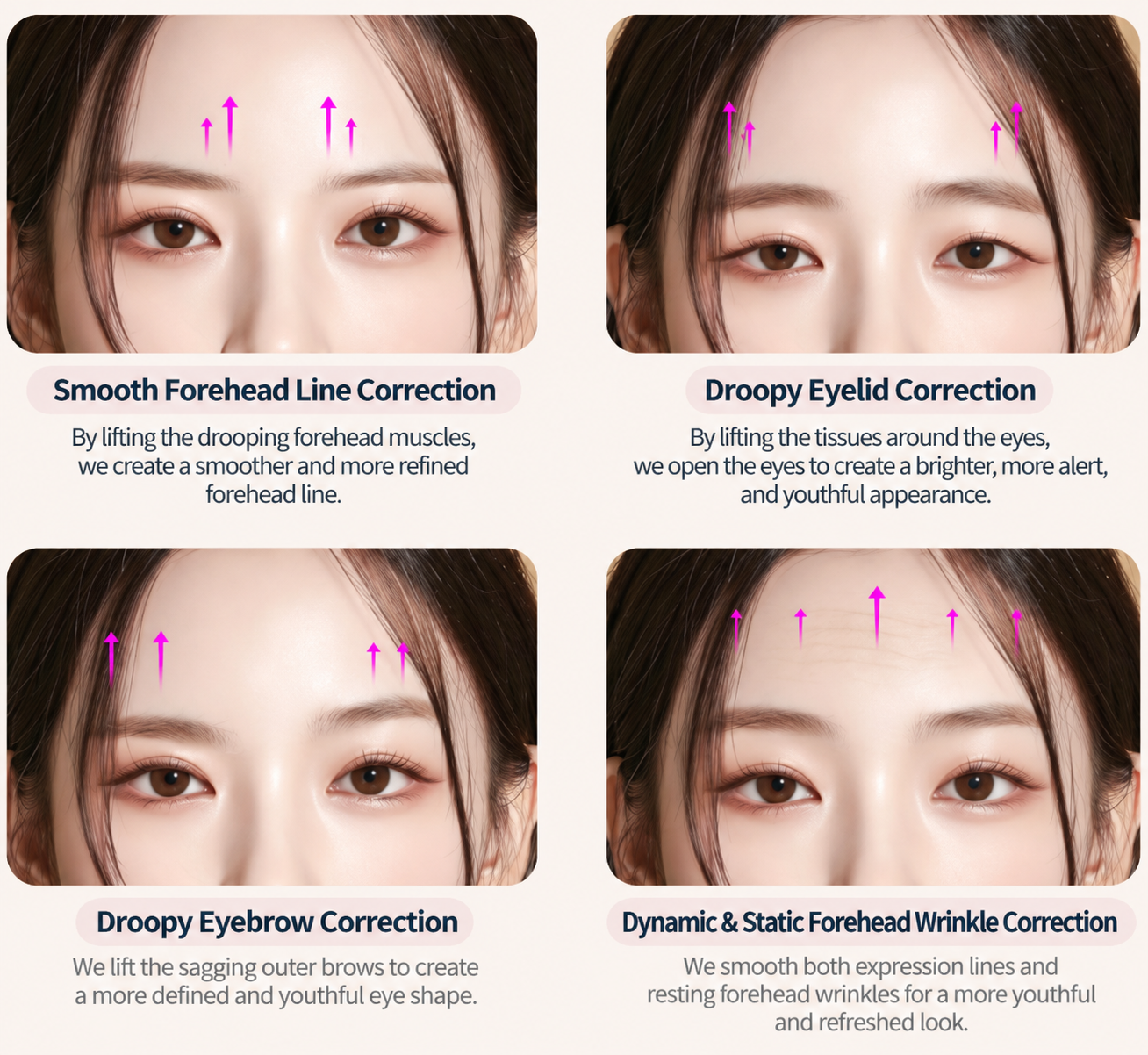
Endoscopic forehead lifting is surgery that lifts the forehead tissues and moves the eyebrows to a higher position, working through small incisions behind the hairline rather than through one long one.
The incisions are several small ones, placed within the hair-bearing scalp.
An endoscope — a thin tube with a camera — lets the surgeon see and release the tissue underneath without opening the forehead.
The forehead and brows are elevated and secured using the selected fixation method.
Frown lines and forehead furrows may also be addressed, depending on anatomy and the surgical plan.
Sedation is required.
The clinic states a surgery duration of approximately one to two hours.
What this procedure changes is position, and that is the distinction worth carrying into a consultation. A low brow and a lined forehead often arrive together but are not the same problem: one is tissue that has descended, the other is skin and muscle activity. Lifting addresses the first directly and the second only partly. The American Society of Plastic Surgeons describes the endoscopic approach in the same terms — instruments placed through small incisions within the hairline, adjusting the tissue and muscle beneath the skin to correct the source of visible creases and furrows — and notes that in the coronal technique, the incision runs ear to ear across the top of the head.
Who Performs Endoscopic Forehead Lifting at Le.J Plastic Surgery
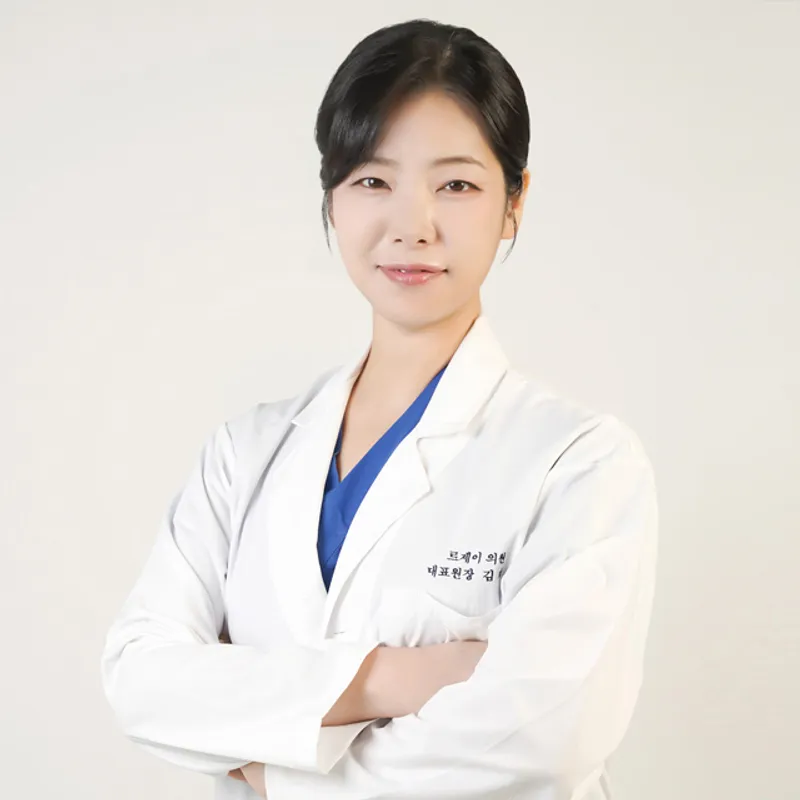
Dr. Kim Ji Sun, M.D., M.S., Ph.D.
Board-certified Otorhinolaryngologist
Endoscopic forehead lifting is performed personally by Dr. Kim Ji Sun, the clinic's founder and Medical Director and the listed performing doctor for the parent Facial Lifting & Contouring specialty.
Dr. Kim is a board-certified otolaryngologist who earned an M.D., a Master's degree and a Ph.D. from Dankook University College of Medicine, completed internship and residency at Dankook University Hospital, trained as a Clinical Fellow in the Department of Otorhinolaryngology at Asan Medical Center, and has served as a Guest Professor at Stanford University School of Medicine in the United States. Forehead lift surgery is one of the core specializations listed on Dr. Kim's profile, alongside rhinoplasty, fat grafting and stem cell therapy.
Dr. Kim's most recent relevant academic activity is a 2026 lecture on non-surgical facial rejuvenation and closed rhinoplasty at the 12th meeting of the Korean Academy of Facial Plastic and Reconstructive Surgery, where Dr. Kim is a regular member and serves on the academic, public-relations and international committees.
Le.J Plastic Surgery is a single-doctor clinic, so the surgeon who assesses you is the surgeon who treats you. For brow surgery that continuity does real work. Where the brow should sit is a judgement about one face, made while looking at eyebrow height and symmetry, forehead lines, eyelid position, hairline, scalp condition and eye closure together — and it has to survive contact with what the endoscope shows underneath.
Who Is a Good Candidate for Endoscopic Forehead Lifting?
Suitable candidates:
Adults in good general health with low or sagging eyebrows, or forehead descent.
Patients with prominent frown lines.
Patients whose upper-eyelid hooding is partly caused by a low brow. The qualifier matters: if the hooding is skin on the eyelid rather than a brow that has dropped, lifting the brow is the wrong operation for it.
Patients with realistic expectations who understand the recovery period and can follow postoperative instructions.
Who should be assessed carefully or postpone:
Patients with medical conditions that substantially increase surgical or anaesthesia risks.
Patients with impaired wound healing or uncontrolled health problems.
Patients with unrealistic expectations.
Smoking, medications, bleeding risk, scalp condition, hairline position and previous facial surgery should all be reviewed before a decision. Two of those are specific to this operation rather than general caution. The incisions sit in hair-bearing scalp, so scalp condition and hair loss around the incisions are part of the risk picture; and hairline position shapes which approach suits a given forehead at all — ASPS notes that for a very high forehead, an incision at the anterior hairline may be recommended instead, so that the brow can be lifted without raising the hairline further.
What to Expect: Procedure, Recovery, and Results Timeline
The consultation reviews medical history, medications, allergies, smoking history, previous facial or eyelid surgery and aesthetic goals. Examination assesses eyebrow height and symmetry, forehead wrinkles, eyelid position, hairline, scalp condition, forehead anatomy and eye closure.
The clinic describes the operation in six steps: the surgeon marks the planned brow position and the small scalp incisions; anaesthesia is administered; several small incisions are made behind the hairline; an endoscope and surgical instruments are used to release the relevant tissues under visualisation; the forehead and brows are elevated and secured using the selected fixation method; and the incisions are closed and dressings applied.
Stage | What the clinic states |
|---|---|
Surgery duration | Approximately 1–2 hours |
Anaesthesia | Sedation |
Visits | 1 preoperative consultation, 1 surgery visit, at least 1–2 postoperative follow-ups |
Recovery | Commonly around 10–14 days |
Suggested stay in Korea | 10–14 days, for initial healing, postoperative assessment and any suture or clip removal |
Flying home | Generally after 10–14 days, if well and without concerning symptoms |
First visible results | Around 10–14 days; initial improvement may show within 2–3 weeks as swelling and bruising subside |
Settling | Tissue settling continues for several months |
The ten-to-fourteen-day figure does a lot of work in that table, and it is the one to plan a trip around. It is simultaneously the recovery estimate, the suggested length of stay, and the point at which the clinic expects a patient to be fit to fly — so compressing it does not just mean travelling while bruised, it means leaving before the postoperative assessment and any suture or clip removal have happened. The NHS makes the category-general case against compressing that window, noting that air travel and major surgery both increase the risk of a blood clot and recommending no flying for 7 to 10 days after facial cosmetic procedures.
Common temporary effects include swelling, bruising, soreness, tightness, forehead or scalp numbness, tingling and itching. The procedure is performed under sedation anaesthesia, so significant pain during surgery is not expected; afterwards, mild to moderate soreness, tightness, swelling, bruising or temporary numbness around the forehead and scalp may occur. Potential complications include bleeding or haematoma, infection, visible or widened scars, hair loss near the incisions, asymmetry, changes in brow movement, nerve injury, poor wound healing, and eye irritation or dryness. Numbness or itching may be temporary or persistent — that second word is the honest one, and it applies to scalp sensation more often than patients expect.
Aftercare covers incision care, prescribed medication, dressings and follow-up. Keep the head elevated as advised, and avoid strenuous exercise, heavy lifting or pressure on the surgical area until cleared. ASPS gives the same instruction for the category and adds one worth noting: do not apply ice or heat to the operated area.
Results take time to read. Initial improvements may be visible within 2–3 weeks as swelling and bruising subside, but tissue settling continues for several months, and results vary with individual anatomy, healing and ageing. The degree of lift and the amount of wrinkle improvement both vary for the same reasons — this operation can elevate a drooping brow, soften some forehead and frown lines, and produce a more refreshed upper-face appearance, but it does not stop ageing and does not guarantee symmetry.
For patients returning to the United States, the practical concerns are managing swelling on a long flight, protecting the surgical area during airport transfers, and arranging follow-up across time zones. If something feels wrong after returning home, patients can reach the clinic's English-speaking counselling manager by phone or email.
Combining Endoscopic Forehead Lifting with Other Treatments
Brow or forehead lifting may be combined with upper or lower blepharoplasty, facelift, neck lift, or selected skin-resurfacing procedures when clinically appropriate. The clinic publishes no per-procedure pages for these, so they are listed without links rather than linked to pages that do not exist.
The alternatives depend on which concern is actually driving the complaint. Botulinum toxin injections address selected dynamic wrinkles or produce mild brow elevation. Upper eyelid surgery addresses excess eyelid skin — the right answer when hooding is the eyelid rather than the brow. And other brow-lift approaches exist: temporal, direct, hairline, or open and coronal lifting, each suited to a different forehead and hairline.
Within the clinic's own range, the useful contrast is surgical versus device-based. Endoscopic forehead lifting repositions tissue. Ultherapy, Thermage and Titanium are energy-based treatments aimed at skin firmness, and Fat Grafting addresses volume rather than position. These options address different concerns and are not interchangeable; the clinic states as much, and the degree of improvement available from each differs accordingly, with surgical lifting generally addressing more pronounced sagging than non-surgical treatment can.
Safety, Precision, and Clinic Standards
Le.J Plastic Surgery is a Registered Medical Institution for Attracting Foreign Patients, certified by the Ministry of Health and Welfare in compliance with the Medical Overseas Expansion and Foreign Patients Attraction Act. This is a registration for treating international patients; it is not an accreditation of any treatment in this category.
The clinic has not published equipment details or technique details specific to this operation, and this page does not supply any in their place. What it does document is structural: every case is assessed and performed by one board-certified otolaryngologist whose listed core specializations include forehead lift surgery, under a preoperative assessment that covers brow height and symmetry, eyelid position, hairline, scalp condition and eye closure before any incision is planned. Postoperative monitoring follows, and the clinic's recovery facilities include hyperbaric oxygen equipment.
For the category's own account of what to ask and what to weigh, ASPS publishes a risks and safety page for brow lift surgery that is written for patients rather than surgeons, and it is a reasonable yardstick when comparing clinics in any country.
Le.J Plastic Surgery publishes neither case volumes nor complication rates for this procedure, and this page claims neither. It also publishes no exclusion list of its own. Both are fair questions at consultation, as is the one worth asking any surgeon in this category: how many of these operations they have performed, how many involved complications, and what follow-up to expect if something goes wrong.
The Bottom Line
Endoscopic forehead lifting raises descended forehead tissue and repositions the eyebrows, through several small incisions hidden in the hair-bearing scalp.
An endoscope lets the surgeon release and elevate the tissue without opening the forehead, and no forehead skin is removed.
The clinic states approximately 1–2 hours under sedation, with recovery commonly around 10–14 days.
Plan 10 to 14 days in Korea; that same window is when the clinic expects a patient to be fit to fly.
It changes brow position. Forehead lines soften partly rather than fully, and upper-eyelid hooding only improves if a low brow is what was causing it.
Frequently Asked Questions
Where are the incisions, and will they show? Several small incisions are made behind the hairline, within the hair-bearing scalp. Visible or widened scars and hair loss near the incisions are both listed among the possible complications, so scalp condition and hairline position are assessed before surgery. If your hairline is already high, that changes which approach is appropriate rather than ruling surgery out.
Will this get rid of my forehead wrinkles? Partly. The operation may soften some forehead and frown lines as well as elevating the brow, but the degree of wrinkle improvement varies with anatomy, technique, healing and ageing. If dynamic lines are the main concern, botulinum toxin injections address that specific problem, and the two are sometimes considered together.
Will it fix hooded upper eyelids? Only if a low brow is part of what is causing the hooding. Where the problem is excess skin on the eyelid itself, upper eyelid surgery is the procedure that addresses it. Distinguishing the two is part of the examination, which assesses brow height and eyelid position together.
How long does the surgery take, and what anaesthesia is used? Approximately one to two hours, under sedation. Significant pain during the operation is not expected; afterwards, mild to moderate soreness, tightness, swelling, bruising or temporary numbness around the forehead and scalp may occur.
How long should I stay in Korea, and when can I fly home? Plan for 10 to 14 days. That covers initial healing, the postoperative assessment and any suture or clip removal, and it is also when the clinic expects patients to be generally able to fly home if they feel well and have no concerning symptoms.
When will I see the result? Initial improvements may be visible within 2 to 3 weeks as swelling and bruising subside, with the clinic citing around 10 to 14 days for results to begin showing. Tissue settling then continues for several months.
How long does it last? Surgical lifting generally addresses more pronounced sagging than non-surgical treatment and its results can last for years, but ageing continues and no treatment stops it. Results vary depending on individual anatomy, healing and ageing.
What do I need to do before surgery? Complete the preoperative medical assessment and disclose all medications, supplements, allergies, smoking history, previous operations and any anaesthesia problems. Previous facial surgery, bleeding risk and scalp condition should all be reviewed as part of that assessment.
Book a Consultation at Le.J Plastic Surgery
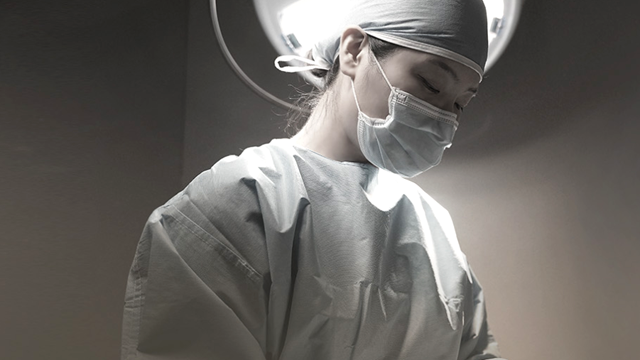
Endoscopic forehead lifting is performed at Le.J Plastic Surgery in Gangnam-gu, Seoul by Dr. Kim Ji Sun. Because where the brow should sit is a judgement about proportion rather than a fixed measurement, the consultation — brow height and symmetry, forehead lines, eyelid position, hairline and scalp condition — is what decides whether this is the right operation or whether an eyelid procedure or a non-surgical treatment addresses your concern better. Consultations run Monday to Friday, 10:00–19:00 KST, and Saturday from 10:00 KST. International enquiries are handled by the clinic's counseling manager, Park Somi, and English-language support is available. If you are travelling from abroad, build the trip around the 10-to-14-day window rather than the surgery date. You can use the clinic's contact page, by phone on +82-2-516-7153, or by email at info@lejplasticsurgery.com.
Disclaimer
This page is for general information only and is not medical advice. Individual results vary and cannot be guaranteed. Suitability for any procedure can only be determined through an in-person medical consultation with a qualified doctor.
Sources & Further Reading
Ready for a Personalized 1:1 Consultation?
Dr. Kim Ji Sun personally conducts every consultation, surgical plan, and follow-up at Le.J Plastic Surgery in Gangnam, Seoul.