Personalized Rhinoplasty & Facial Aesthetics in Gangnam, Seoul · Tel: +82-2-6954-1988
en-US

CLINICAL PROCEDURE GUIDE
Botulinum Toxin
Botulinum toxin injections at Le.J Plastic Surgery in Gangnam, Seoul temporarily reduce muscle activity to soften dynamic facial wrinkles, performed personally by Dr. Ji Sun Kim after medical assessment.

Botulinum Toxin in Seoul at Le.J Plastic Surgery

Medically reviewed by Dr. Kim Ji Sun, M.D., M.S., Ph.D., Board-Certified Otolaryngologist · Le.J Plastic Surgery, Gangnam-gu, Seoul
Botulinum toxin injections use a purified neurotoxin to temporarily reduce muscle activity. Depending on the product and treatment area, they may soften dynamic facial wrinkles, such as forehead lines and crow's feet, or address selected medical and aesthetic concerns. At Le.J Plastic Surgery in Gangnam-gu, Seoul it sits within the clinic's Skin Care range, and it is performed personally by Dr. Kim Ji Sun, the clinic's founder and Medical Director and the listed performing doctor for the parent Skin Care specialty.
Two things about this treatment are fixed and worth stating before anything else: the effect is temporary, and it works on movement. It does not address every type of wrinkle, and it does not replace surgery when structural changes are present. A line that is visible when the face is at rest is a different problem from a line that appears when the face moves, and only the second is what this injection is for.
What Is Botulinum Toxin Treatment?
Botulinum toxin is a purified neurotoxin injected in small amounts into selected facial muscles, where it temporarily reduces muscle activity so that the overlying skin creases less with expression.
The stated targets are dynamic facial wrinkles, such as forehead lines and crow's feet, and selected medical and aesthetic concerns.
Results depend on the indication, the dose, the injection placement and individual response.
Initial effects may begin within 1–3 days, with improvement commonly developing over approximately 1–2 weeks.
Effects often last around 3–4 months, although duration varies by product, treatment area, dose and individual response.
The injection appointment often takes about 10–30 minutes, excluding consultation and preparation.
It is a drug rather than a device treatment, and that distinction is the reason the medical history review before a first appointment is longer than the injection itself. The category's own patient material is clear about what it is and is not: the U.S. Food and Drug Administration notes that botulinum toxin products approved for facial wrinkles are not dermal fillers but injectable drugs that work by keeping muscles from tightening, so the wrinkles do not show as much. The American Academy of Dermatology describes the established cosmetic uses as frown lines between the eyebrows, crow's feet, and excessive underarm sweating where treatment applied to the skin has not worked well enough. The same body's patient FAQ puts the duration in the same range the clinic does, noting that the effect lasts about 3 to 4 months, and sometimes longer. All three are statements about the category, and all three are reasonable things to hold any clinic to, in any country.
The clinic has not published technique details specific to its own protocol, and this page does not supply any in their place. It has likewise not confirmed approved claims of its own for this treatment, so nothing beyond the stated purpose above is asserted here — not an efficacy figure, not a comparison, and not a regulatory status. Nor does it publish which product it uses; that is a fair question at consultation, and a reasonable one to ask anywhere.
What the clinic does state about equipment is modest and exactly what a patient should expect to see: sterile fine-gauge needles, syringes, antiseptic supplies, and the selected botulinum toxin product.
Who Performs Botulinum Toxin Treatment at Le.J Plastic Surgery

Dr. Kim Ji Sun, M.D., M.S., Ph.D.
Board-certified Otorhinolaryngologist
Botulinum Toxin treatment is performed personally by Dr. Kim Ji Sun, the clinic's founder and Medical Director and the listed performing doctor for the parent Skin Care specialty.
Dr. Kim is a board-certified otolaryngologist who earned an M.D., a Master's degree and a Ph.D. from Dankook University College of Medicine, completed internship and residency at Dankook University Hospital, trained as a Clinical Fellow in the Department of Otorhinolaryngology at Asan Medical Center, and has served as a Guest Professor at Stanford University School of Medicine in the United States.
Dr. Kim's most recent relevant academic activity is a 2026 lecture on non-surgical facial rejuvenation and closed rhinoplasty at the 12th meeting of the Korean Academy of Facial Plastic and Reconstructive Surgery, where Dr. Kim is a regular member and serves on the academic, public-relations and international committees.
Le.J Plastic Surgery is a single-doctor clinic, so the surgeon who assesses you is the surgeon who treats you. The assessment here is an anatomical one rather than a conversation about products: the provider reviews medical history, medications, allergies, previous injections and treatment goals, assesses facial movement, muscle activity and relevant anatomy, and then explains expected results, limitations, potential adverse effects, alternatives and follow-up recommendations. Placement and dose follow from that assessment, and they are the two variables that decide whether a result looks natural or does not.
Who Is a Good Candidate for Botulinum Toxin Treatment?
Suitable candidates:
Adults seeking temporary improvement in expression-related wrinkles, or another appropriate indication.
Patients whose treatment area, medical history, muscle activity and expectations support treatment on the provider's assessment.
Patients who understand that the effect is temporary and will need repeating to be maintained.
Who should avoid or postpone:
People with certain neuromuscular disorders.
People with infection at the proposed injection site.
People with a known allergy to a product's ingredients.
Pregnancy, breastfeeding, certain medications and previous reactions all require discussion with the treating clinician.
Anyone with a history of swallowing or breathing problems should raise it explicitly, because the clinic lists it among the things to disclose before treatment and it bears directly on the serious risk described further down this page. The honest version of the candidacy question is not whether someone is permitted to have the injection, but whether the lines that bother them are the kind this injection acts on — a question settled by watching the face move, in person.
What to Expect: Procedure, Recovery, and Results Timeline
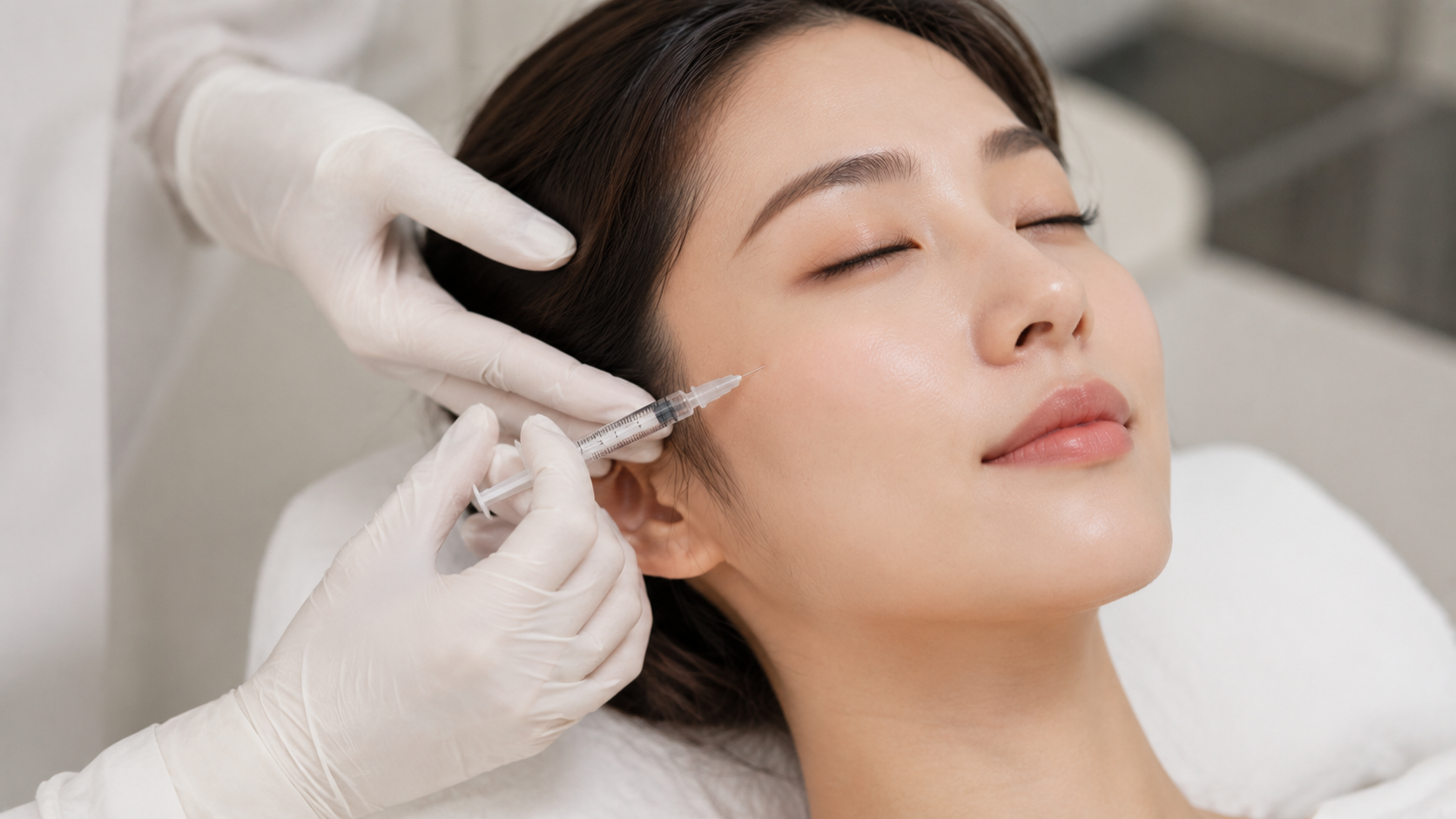
The clinic describes the appointment plainly: the treatment area is assessed and cleaned, the provider identifies the appropriate sites and administers small amounts of botulinum toxin using a fine needle, and post-treatment instructions are given, including when to seek medical attention.
Stage | What the clinic states |
|---|---|
Appointment length | Often about 10–30 minutes, excluding consultation and preparation |
Anaesthesia | Generally not required; ice or other comfort measures may be used when appropriate |
During treatment | Brief pinching, stinging or mild discomfort |
Immediately after | Most patients resume ordinary activities shortly afterwards |
Early recovery | Minor redness or swelling often improves within hours to a few days; bruising may last longer |
First effects | May begin within 1–3 days, developing gradually over the following days |
Full effect | Generally assessed around 10–14 days after treatment |
Duration | Commonly about 3–4 months, varying by product, area, dose and individual |
A follow-up may be recommended to assess the result, and the clinic is specific that patients travelling to Korea should arrange follow-up and complication support before returning home. For botulinum toxin injections a stay of 1–2 days may be sufficient for many patients, with extra time if a follow-up assessment is recommended or treatments are being combined. Many patients can fly home the same day or the next day; confirm travel timing with the provider, especially if side effects occur or other procedures are planned. If something feels wrong after returning home, patients can reach the clinic's English-speaking counselling manager by phone or email.
Aftercare is short and specific. Follow the treating provider's instructions, avoid rubbing or massaging the injection sites, and observe any recommended temporary activity restrictions, including those on exercise. Contact the clinic about concerning or persistent symptoms — and seek urgent medical care for difficulty breathing or swallowing, or widespread weakness.
Combining Botulinum Toxin with Other Treatments
Dermal fillers — the clinic names these as a possible combination where clinically suitable, and is explicit that the two are not interchangeable: botulinum toxin reduces muscle activity, while fillers restore or add volume.
Selected skin rejuvenation treatments — named as a possible combination, depending on clinical suitability.
Other procedures — depending on assessment, with sequencing accounting for risks, recovery and individual goals.
The clinic publishes no per-procedure pages for several of these, so they are listed without links rather than linked to pages that do not exist.
The distinction in the first item is the one patients most often arrive without, and it decides whether a plan makes sense. A crease caused by repeated movement and a hollow caused by lost volume look similar in a mirror and respond to different things; treating the second with the first produces a disappointment that no amount of dose adjustment fixes. Alternatives named by the clinic include topical skin care, selected laser treatments, chemical peels, dermal fillers and surgical procedures, depending on the concern. Sequencing — what is done first, and how far apart — should account for risks, recovery and goals, and is a clinical decision rather than a scheduling preference.
Safety, Precision, and Clinic Standards
Le.J Plastic Surgery is a Registered Medical Institution for Attracting Foreign Patients, certified by the Ministry of Health and Welfare in compliance with the Medical Overseas Expansion and Foreign Patients Attraction Act. This is a registration for treating international patients; it is not an accreditation of any treatment in this category.
The clinic has not published a risk-reduction protocol specific to this procedure, so none is described here in its place.
The common effects are temporary and local: injection-site pain, redness, swelling, bruising or headache, and in some patients temporary eyelid or brow drooping or facial asymmetry. Depending on the injection site, unwanted muscle weakness or changes in facial expression may occur. The category's own published figures describe the same pattern — the FDA lists facial weakness, eyelid drooping and brow drooping among the common effects seen in trials of botulinum toxin products, and notes that cosmetic use is not recommended during pregnancy or lactation.
One risk is rare and is the reason this is a medical treatment rather than a cosmetic service. Toxin effects can spread beyond the injection site and cause serious symptoms, including difficulty swallowing or breathing. These require immediate medical attention. That is not a reason to refuse treatment, but it is the reason to have it from a physician who assessed you, in a setting where the product's handling is accounted for, and to know before you travel who you will contact if something changes after you are home.
Preparation reduces the ordinary risks. Disclose all medications, supplements, allergies, medical conditions, previous botulinum toxin treatments, and any history of swallowing or breathing problems; ask whether any medication or supplement needs special consideration, especially blood-thinning medication; and do not stop prescribed medication without medical advice. Avoid alcohol for 24 hours before treatment if possible, as it may increase bruising risk, and do not proceed if the injection site has an active infection until it has been appropriately assessed.
Le.J Plastic Surgery publishes neither case volumes nor complication rates for this procedure, and this page claims neither.
The Bottom Line
Botulinum toxin temporarily reduces muscle activity, softening wrinkles that appear with expression rather than filling lines caused by lost volume.
The appointment often takes about 10–30 minutes, excluding consultation and preparation.
First effects may appear within 1–3 days, the full effect is generally assessed around 10–14 days, and the result commonly lasts about 3–4 months.
It does not address every type of wrinkle and does not replace surgery when structural changes are present.
Rare spread of toxin effects, including difficulty swallowing or breathing, requires immediate medical attention.
The clinic publishes no protocol details, no product name, no outcome figures and no price for this service, and none are supplied here.
Frequently Asked Questions
How soon will it work, and how long will it last? Initial effects may begin within 1–3 days, with improvement developing over roughly 1–2 weeks; the full effect is generally assessed around 10–14 days after treatment. The result is temporary and commonly lasts about 3–4 months, varying by product, treatment area, dose and individual response — so maintaining it means repeating it.
Will it get rid of all my wrinkles? No. It acts on muscle activity, so it addresses lines that appear with expression. The clinic states directly that it does not address every type of wrinkle and does not replace surgery when structural changes are present. Lines caused by lost volume are a different problem, and the clinic is explicit that botulinum toxin and volume-restoring injectables are not interchangeable.
Does it hurt, and is numbing used? Anaesthesia is generally not required. Patients may feel brief pinching, stinging or mild discomfort during the injections, and ice or other comfort measures may be used when appropriate. The appointment itself is short — often about 10–30 minutes, excluding consultation and preparation.
What are the side effects I should expect, and which ones are serious? Commonly: temporary injection-site pain, redness, swelling, bruising or headache, and sometimes temporary eyelid or brow drooping or facial asymmetry. Seriously and rarely: toxin effects can spread beyond the injection site and cause difficulty swallowing, speaking or breathing, or widespread weakness. Those symptoms need immediate medical attention, not a wait-and-see.
Who should avoid this treatment? People with certain neuromuscular disorders, an infection at the proposed injection site, or a known allergy to a product's ingredients. Pregnancy, breastfeeding, certain medications and any previous reaction all need to be discussed with the treating clinician first, and a history of swallowing or breathing problems should be raised explicitly.
How should I prepare, and what should I avoid beforehand? Disclose all medications, supplements, allergies, medical conditions and previous botulinum toxin treatments, with particular attention to blood-thinning medication. Avoid alcohol for 24 hours before treatment if possible, since it may increase the risk of bruising. Do not stop prescribed medication without medical advice, and postpone if the injection site is infected until it has been assessed.
How long should I stay in Korea, and when can I fly home? A stay of 1–2 days may be sufficient for many patients, with extra time if a follow-up assessment is recommended or you are combining treatments. Many patients fly home the same day or the next day. Confirm the timing with the provider, particularly if you have side effects or other procedures planned, and arrange follow-up and complication support before you leave.
Can I have it again if I was not happy with a previous result? Repeat treatment is possible, and the assessment is where the previous result is discussed — placement, dose and the muscles actually responsible for the lines in question. Bring the details of what was injected previously, and when, since the clinic asks for previous botulinum toxin treatments to be disclosed as part of the medical history.
Book a Consultation at Le.J Plastic Surgery

Botulinum Toxin treatment is offered at Le.J Plastic Surgery in Gangnam-gu, Seoul by Dr. Kim Ji Sun, within the clinic's Skin Care range. Because placement and dose follow from how your face actually moves, the consultation is where it is established whether this is the right answer to the lines that bother you. Consultations run Monday to Friday, 10:00–19:00 KST, and Saturday from 10:00 KST. International enquiries are handled by the clinic's counseling manager, Park Somi, and English-language support is available. You can use the clinic's contact page, by phone on +82-2-516-7153, or by email at info@lejplasticsurgery.com.
Disclaimer
This page is for general information only and is not medical advice. Individual results vary and cannot be guaranteed. Suitability for any procedure can only be determined through an in-person medical consultation with a qualified doctor.
Sources & Further Reading
Ready for a Personalized 1:1 Consultation?
Dr. Kim Ji Sun personally conducts every consultation, surgical plan, and follow-up at Le.J Plastic Surgery in Gangnam, Seoul.