Personalized Rhinoplasty & Facial Aesthetics in Gangnam, Seoul · Tel: +82-2-6954-1988
en-US
CLINICAL PROCEDURE GUIDE
Closed Rhinoplasty
Closed rhinoplasty at Le.J Plastic Surgery in Seoul reshapes the bridge, tip and proportions of the nose through incisions inside the nostrils.

Closed Rhinoplasty in Seoul at Le.J Plastic Surgery

Medically reviewed by Dr. Kim Ji Sun, M.D., M.S., Ph.D., Board-Certified Otolaryngologist · Le.J Plastic Surgery, Gangnam-gu, Seoul
Closed rhinoplasty is defined by its access route rather than by what is changed: the incisions are made inside the nostrils, so there is generally no visible external incision scar. Through that route the surgeon can modify the shape, proportions and contour of the nose, addressing the bridge, the tip, or the overall nasal shape. At Le.J Plastic Surgery in Gangnam, Seoul it sits within the clinic's rhinoplasty programme and is performed personally by Dr. Kim Ji Sun, the clinic's founder and Medical Director and the listed performing doctor for the parent Rhinoplasty specialty.
What Is Closed Rhinoplasty?
Closed rhinoplasty is a surgical technique that reshapes the nose through incisions made inside the nostrils, without an external incision across the columella.
The defining feature is the access route, not the goal. The same change can often be made through an open or a closed approach; which is appropriate depends on anatomy and on how much surgical exposure the plan requires.
Because the incisions are internal, there is generally no visible external incision scar.
It can address the nasal bridge, the tip, or the overall shape, and the nasal bone and cartilage are adjusted as needed to reach the planned shape.
A nasal support or splint may be applied at the end of the operation.
At this clinic it is performed under sleep (sedation) anaesthesia.
The clinic's broader approach is relevant here: most of its nasal techniques work through a closed route, the patient's own cartilage, or both. Closed rhinoplasty is the general-purpose member of that group — the one defined purely by access, where the others are defined by what material is used or which part of the nose is treated.
Who Performs Closed Rhinoplasty at Le.J Plastic Surgery
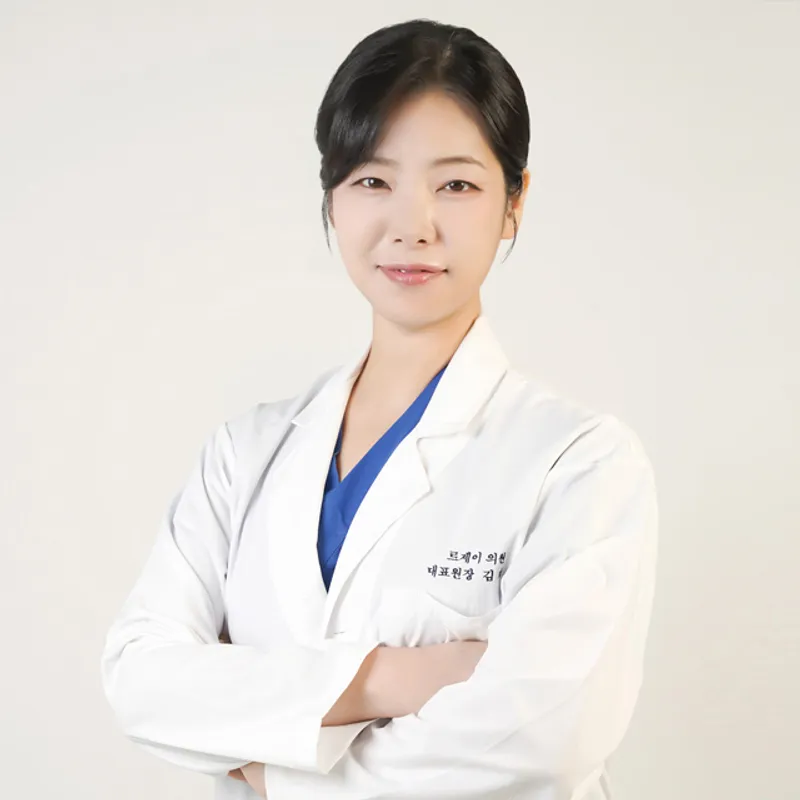
Dr. Kim Ji Sun, M.D., M.S., Ph.D.
Board-certified Otorhinolaryngologist
Closed rhinoplasty is performed personally by Dr. Kim Ji Sun, the clinic's founder and Medical Director and the listed performing doctor for the parent Rhinoplasty specialty.
Dr. Kim is a board-certified otolaryngologist who earned an M.D., a Master's degree and a Ph.D. from Dankook University College of Medicine, completed internship and residency at Dankook University Hospital, trained as a Clinical Fellow in the Department of Otorhinolaryngology at Asan Medical Center, and has served as a Guest Professor at Stanford University School of Medicine in the United States.
Dr. Kim served as Rhinoplasty Hands-on Course Director from 2020 to 2022 under the Korean Society of Facial Plastic and Reconstructive Surgery, was an invited speaker on functional rhinoplasty at the Seoul National University Hospital rhinoplasty workshop in 2021, and lectured on non-incisional rhinoplasty at the 11th KSFPRS educational course in 2025.
Le.J Plastic Surgery is a single-doctor clinic, so the surgeon who assesses your nose is the surgeon who operates on it. The clinic's stated position is that its representative director is an ENT specialist and that functional considerations are weighed alongside appearance when a nasal operation is planned.
Who Is a Good Candidate for Closed Rhinoplasty?
Suitable candidates:
Adults in good general health, with realistic expectations, who want to improve the shape or proportions of the nose.
Patients who prefer to avoid an external incision, which is a common reason for choosing this approach.
Patients whose anatomy allows the planned change to be made through internal access — a judgement that depends on nasal anatomy, skin thickness, breathing function and the extent of the change wanted.
Who should postpone or be reconsidered:
Patients with uncontrolled medical conditions, active infections, or certain bleeding disorders.
Patients with other factors that increase surgical risk, or who are not medically fit for surgery.
Patients who are pregnant, or who have conditions affecting healing — both call for a discussion of suitability with the surgeon.
Patients with unrealistic expectations. This is listed alongside the medical criteria rather than beneath them, and it is as common a reason for a poor outcome as any physiological one.
Across its rhinoplasty work the clinic applies the general conditions as well: completed facial growth, physically healthy, non-smoking. Obstructive sleep apnoea requires special consideration. The American Society of Plastic Surgeons lists the same conditions for the category, and adds a positive outlook with realistic goals.
What to Expect: Procedure, Recovery, and Results Timeline
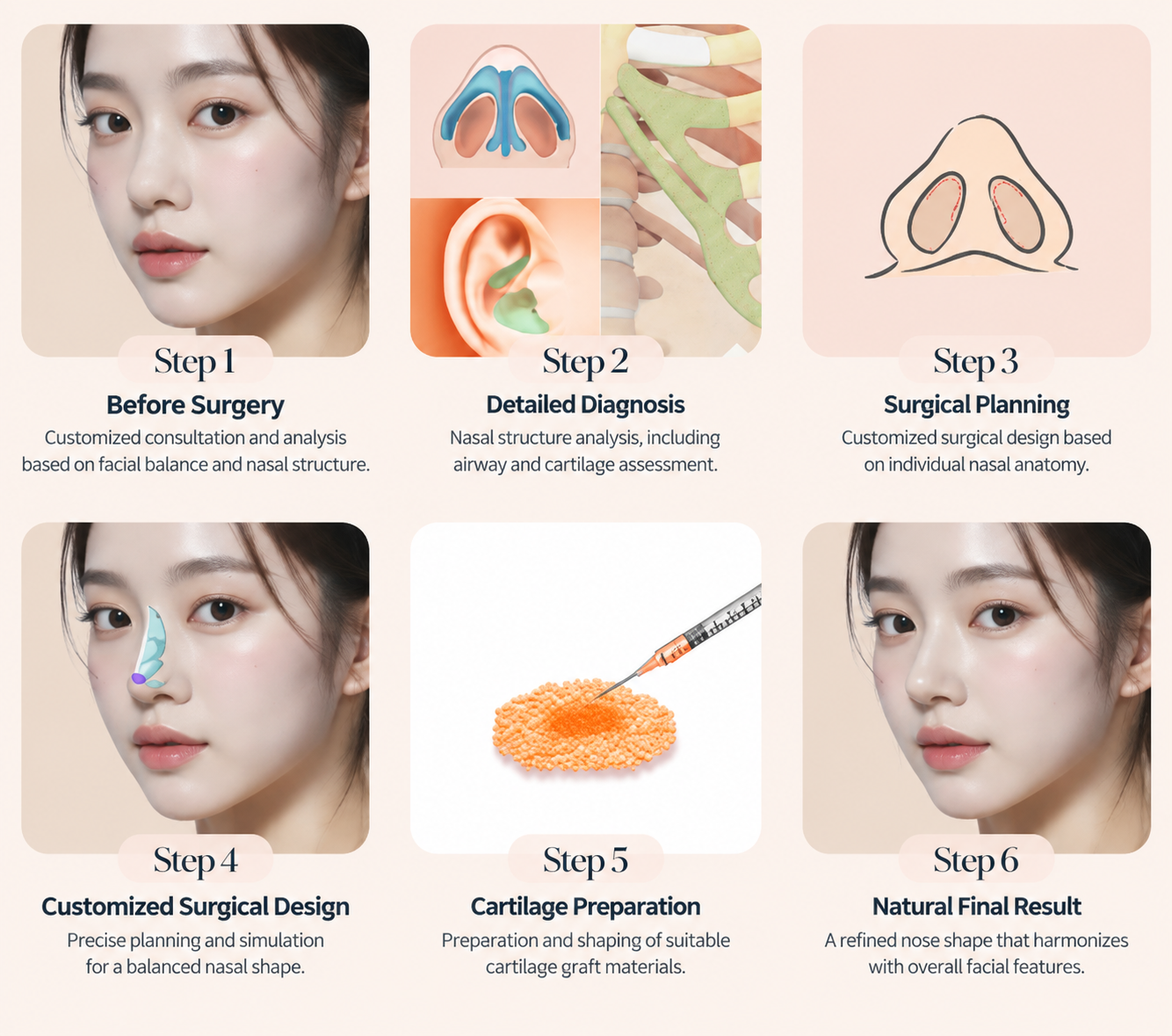
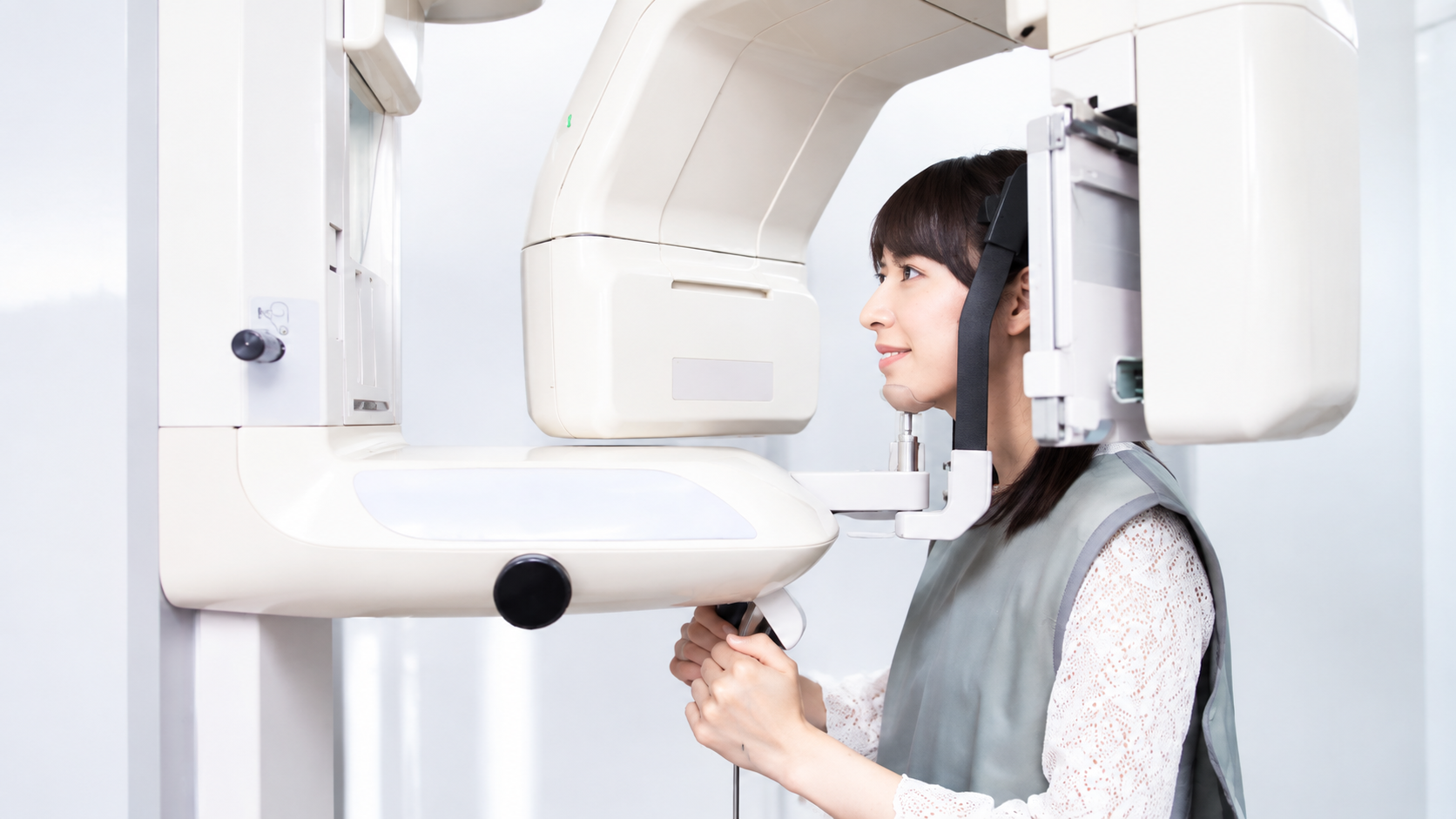
The consultation covers your concerns, the nasal shape you want, your medical history, previous nasal procedures and any breathing difficulties. The surgeon examines nasal structure, facial proportions, skin characteristics and functional concerns before recommending a surgical plan. The clinic identifies 3D-CT and high-resolution endoscopy as part of its assessment equipment, used where the case calls for it.
The operation itself follows a set sequence: anaesthesia is administered, incisions are made inside the nostrils, the nasal bone and cartilage are adjusted to the planned shape, the incisions are closed, and a nasal support or splint is applied if needed.
Stage | What the clinic states |
|---|---|
Operation time | Commonly around one to three hours, depending on complexity |
Anaesthesia | Sleep (sedation) anaesthesia |
Taping | Removed around day 3 |
Initial recovery | Approximately one to two weeks |
Stay in Korea | Approximately 7–10 days, for postoperative checks, swelling assessment and splint or stitch removal |
Residual swelling | Especially around the tip, several months or longer |
Final result | Around 6–12 months or longer, depending on procedure and healing |
Flying home is not a fixed date. The clinic's position is that timing depends on recovery, swelling, bleeding and the surgeon's assessment, and that patients should obtain medical clearance before flying and confirm travel precautions with the surgical team. For the category as a whole, while initial swelling subsides within a few weeks, the nasal contour can take up to a year to fully refine.
Common temporary effects are swelling, bruising, tenderness, congestion and mild discomfort, varying in degree and duration between patients. Possible complications include bleeding, infection, scarring inside the nose, asymmetry, changes in sensation, breathing difficulties, dissatisfaction with the appearance, and the potential need for revision surgery. Anaesthesia carries its own risks, which the surgeon should explain individually before treatment.
The category's baseline risks sit underneath those. The NHS notes that any operation also carries a small risk of excessive bleeding, a blood clot in a vein, infection, or an allergic reaction to the anaesthetic, and that nose reshaping can also occasionally result in permanent breathing difficulty, damage to the cartilage wall between the nostrils, an altered sense of smell, or heavy nosebleeds. It is also common after nose reshaping to breathe through the mouth for a week or so, to have a stiff and numb nose, to have soreness, swelling and bruising around the eyes for up to three weeks, and to have light nosebleeds.
Aftercare: follow the surgeon's instructions for wound care, medication, cleaning and any nasal splint or dressing; avoid pressure on the nose, strenuous exercise and activities that could cause nasal injury until cleared; attend the scheduled follow-up appointments. Seek prompt medical attention for severe pain, heavy bleeding, fever or breathing difficulties.
One practical point about the first weeks that patients rarely plan for: the clinic's restriction covers pressure on the nose, strenuous exercise, and any activity that could cause nasal injury — three separate categories, of which only the second is obvious. The clinic does not publish a fixed day-by-day schedule for lifting those restrictions, and the reason is that the answer depends on what was done inside the nose; the instruction is that the surgeon clears them. Asking for the list at the postoperative review, rather than inferring it, is the practical version of that.
For patients flying back to the United States, the concerns the clinic hears most are managing swelling on a long flight, protecting the nose during airport transfers, and arranging follow-up across time zones. If something feels wrong after returning home, patients can reach the clinic's English-speaking counselling manager by phone or email.
Combining Closed Rhinoplasty with Other Treatments
Rhinoplasty may sometimes be combined with procedures such as septoplasty or other facial procedures when clinically appropriate. Combining operations affects anaesthesia, recovery, risk and cost, and the clinic's position is that the surgeon decides whether a combined approach suits the individual patient rather than treating it as a default upgrade. At programme level, the clinic states that procedures can combine bridge and tip reshaping with dermal grafting or facial lifting where appropriate.
Alternatives are worth understanding as a set rather than a ranking. Open rhinoplasty generally includes an incision across the columella to improve surgical access, and remains the right answer where anatomy demands that exposure. Non-surgical injectable nasal contouring is a different proposition altogether, with its own risks. And no treatment is a legitimate option. Within this clinic's own range, non-implant rhinoplasty is defined by using the patient's own cartilage from bridge through tip, Cell Fix™ Nose is a nasal-tip procedure using finely processed autologous cartilage, and alar reduction addresses the nostrils and nasal base rather than the bridge or tip. Revision and complex cases are assessed individually by Dr. Kim Ji Sun at consultation.
Safety, Precision, and Clinic Standards
Le.J Plastic Surgery is a Registered Medical Institution for Attracting Foreign Patients, certified by the Ministry of Health and Welfare in compliance with the Medical Overseas Expansion and Foreign Patients Attraction Act.
The clinic's stated safety process begins with preoperative assessment of nasal anatomy, facial proportions and relevant functional concerns before surgical planning, with 3D CT imaging and nasal endoscopy used when appropriate to support that assessment. Technique is matched to the patient's anatomy and goals rather than applied from a standard protocol. Postoperative monitoring follows, and the clinic's recovery facilities include hyperbaric oxygen equipment.
The AAO-HNS Foundation's clinical practice guideline on improving nasal form and function after rhinoplasty is the category's own account of good practice, and is a reasonable yardstick when comparing surgeons in any country.
Le.J Plastic Surgery publishes neither case volumes nor complication rates for this procedure, and this page claims neither. It also publishes no exclusion list of its own. Both are fair questions at consultation, as is the one worth asking any surgeon in this category: how many of these operations they have performed, how many involved complications, and what follow-up to expect if something goes wrong.
The Bottom Line
Closed rhinoplasty is defined by its access route — incisions inside the nostrils, generally leaving no visible external scar.
Through that route the bridge, the tip or the overall nasal shape can be changed; the operation commonly takes one to three hours.
It is performed under sleep anaesthesia by Dr. Kim Ji Sun, a board-certified otolaryngologist with 20 years of experience and 4,000+ clinical cases.
Taping comes off around day 3, initial recovery runs one to two weeks, and the clinic plans 7–10 days in Korea.
Residual tip swelling can take several months, with the final result at around 6–12 months or longer.
Frequently Asked Questions
What is the difference between closed and open rhinoplasty? Access. Closed rhinoplasty works through incisions inside the nostrils; open rhinoplasty generally includes an incision across the columella — the strip of tissue between the nostrils — to give the surgeon more direct exposure. The closed route generally avoids a visible external scar. Which one suits you depends on your anatomy and on how much exposure the planned change requires, and that is decided at examination.
Will I have a visible scar? Generally not from the incisions, because they are inside the nostrils. Scarring inside the nose is still listed among the possible complications, as is scarring generally across the clinic's nasal work.
How long will I be in Korea? The clinic plans approximately 7–10 days for international patients having this operation, covering postoperative checks, assessment of swelling, and removal of splints or stitches where required. The recommended stay varies with technique and individual recovery. Do not book a return flight on the assumption that taping removal at day 3 means you are finished.
When can I fly? When the surgeon says so. The clinic's position is that timing depends on your recovery, swelling, bleeding and the surgeon's assessment, and that you should obtain medical clearance before flying and confirm travel precautions with the surgical team.
How long until my nose settles? Initial recovery is around one to two weeks. Residual swelling, especially around the tip, can take several months or longer, and the final result commonly arrives at around 6–12 months. Surgical changes are generally long-lasting, though ageing, injury and tissue changes can affect the nose over time.
Will it affect my breathing? Breathing difficulties appear on the risk list for this operation, and the clinic's assessment includes functional concerns alongside appearance. If you already have a breathing problem, say so at consultation — it changes the plan rather than ruling out surgery, and the clinic states that its representative director is an ENT specialist.
What should I do before surgery? Disclose your medical history, allergies, medications, supplements, smoking status and any previous nasal surgery. Follow the surgeon's instructions on fasting, medication adjustments and preparation for anaesthesia, and arrange transport and postoperative assistance where needed. Tell the clinic about any illness, infection or new health concern before the procedure.
Book a Consultation at Le.J Plastic Surgery
Closed rhinoplasty at Le.J Plastic Surgery in Gangnam, Seoul begins with an examination of nasal structure, facial proportions and breathing function — which is also where the choice between a closed and an open approach is made. Consultations run Monday to Friday, 10:00–19:00 KST, and Saturday from 10:00 KST. International enquiries are handled by the clinic's counseling manager, Park Somi, and English-language support is available. If you are travelling from abroad, plan the trip around the full 7–10 days rather than the operation alone. You can use the clinic's contact page, by phone on +82-2-516-7153, or by email at info@lejplasticsurgery.com.
Disclaimer
This page is for general information only and is not medical advice. Individual results vary and cannot be guaranteed. Suitability for any procedure can only be determined through an in-person medical consultation with a qualified doctor.
Sources & Further Reading
Ready for a Personalized 1:1 Consultation?
Dr. Kim Ji Sun personally conducts every consultation, surgical plan, and follow-up at Le.J Plastic Surgery in Gangnam, Seoul.