Personalized Rhinoplasty & Facial Aesthetics in Gangnam, Seoul · Tel: +82-2-6954-1988
en-US
CLINICAL PROCEDURE GUIDE
Cell Fix™ Nose
Cell Fix™ Nose at Le.J Plastic Surgery in Seoul refines the nasal tip with the patient's own finely processed cartilage, through a closed approach.

Cell Fix™ Nose in Seoul at Le.J Plastic Surgery

Medically reviewed by Dr. Kim Ji Sun, M.D., M.S., Ph.D., Board-Certified Otolaryngologist · Le.J Plastic Surgery, Gangnam-gu, Seoul
Cell Fix™ Nose is Le.J Plastic Surgery's nasal-tip procedure, built around the patient's own cartilage rather than an artificial implant. The clinic describes it as finely minced autologous cartilage injected into the nasal tip, with tip height adjustable in small increments, performed through a closed approach that avoids an incision under the nose. It sits inside the clinic's wider rhinoplasty programme and is performed personally by Dr. Kim Ji Sun, the clinic's founder and Medical Director and the listed performing doctor for the parent Rhinoplasty specialty.
What Is Cell Fix™ Nose?
Cell Fix™ Nose is a nasal-tip procedure that uses the patient's own finely processed cartilage to adjust the shape and height of the tip.
The graft material is autologous — the patient's own tissue — rather than a synthetic implant.
The clinic describes the cartilage as finely minced, which is what allows tip height to be adjusted in small increments rather than in one step.
It uses a closed approach, meaning no incision is made across the columella under the nose.
Its scope is the nasal tip. It is not a bridge procedure, and it is not a nostril-narrowing procedure.
Sleep anaesthesia (sedation) is used so the patient remains relaxed and comfortable during the procedure.
Two limits, stated rather than glossed. The clinic's own documentation for this service is written in conditional terms — it states that the exact purpose, technique, materials and expected results depend on the confirmed method, and leaves several fields for the clinic to confirm. What is firmly documented is the description above: a nasal-tip procedure using finely processed autologous cartilage, closed approach, sedation. Anything more specific than that belongs to the consultation, not to this page.
Who Performs Cell Fix™ Nose at Le.J Plastic Surgery

Dr. Kim Ji Sun, M.D., M.S., Ph.D.
Board-certified Otorhinolaryngologist
Cell Fix™ Nose is performed personally by Dr. Kim Ji Sun, the clinic's founder and Medical Director and the listed performing doctor for the parent Rhinoplasty specialty.
Dr. Kim is a board-certified otolaryngologist who earned an M.D., a Master's degree and a Ph.D. from Dankook University College of Medicine, completed internship and residency at Dankook University Hospital, trained as a Clinical Fellow in the Department of Otorhinolaryngology at Asan Medical Center, and has served as a Guest Professor at Stanford University School of Medicine in the United States.
Dr. Kim served as Rhinoplasty Hands-on Course Director from 2020 to 2022 under the Korean Society of Facial Plastic and Reconstructive Surgery, was an invited speaker on functional rhinoplasty at the Seoul National University Hospital rhinoplasty workshop in 2021, and lectured on non-incisional rhinoplasty at the 11th KSFPRS educational course in 2025.
Le.J Plastic Surgery is a single-doctor clinic, so the surgeon who assesses your nose is the surgeon who operates on it. For a tip procedure this matters more than it might sound, because how much cartilage is harvested and how finely it is processed are judgements made during the operation rather than decided in advance.
Who Is a Good Candidate for Cell Fix™ Nose?
Suitable candidates:
Adults seeking a modest change to the shape or height of the nasal tip, who understand the limitations and risks and have been medically assessed.
Patients who prefer their own tissue to an artificial implant in the treated area.
Patients who have completed facial growth, are physically healthy, do not smoke, and hold realistic expectations — the general candidacy conditions the clinic applies across its rhinoplasty work.
Who should be assessed differently or postpone:
Patients seeking substantial size reduction, major structural changes, or correction of significant breathing problems. These may require a surgical or specialist assessment rather than a tip procedure.
Anyone with an active infection at the treatment site.
Anyone with relevant allergies or contraindications to the intended materials.
Patients who are pregnant or breastfeeding, have bleeding disorders, or take anticoagulants — each requires individual assessment.
Patients with previous nasal surgery or previous nasal injections, which also require individual assessment.
Patients with uncontrolled medical conditions, significant wound-healing problems, or unrealistic expectations. Obstructive sleep apnoea requires special consideration.
The American Society of Plastic Surgeons lists the general conditions for the category — completed facial growth, physical health, not smoking, and a positive outlook with realistic goals. Technique is not among them. The consultation is where that is settled, and it is reasonable to arrive without having decided which technique you want.
What to Expect: Procedure, Recovery, and Results Timeline
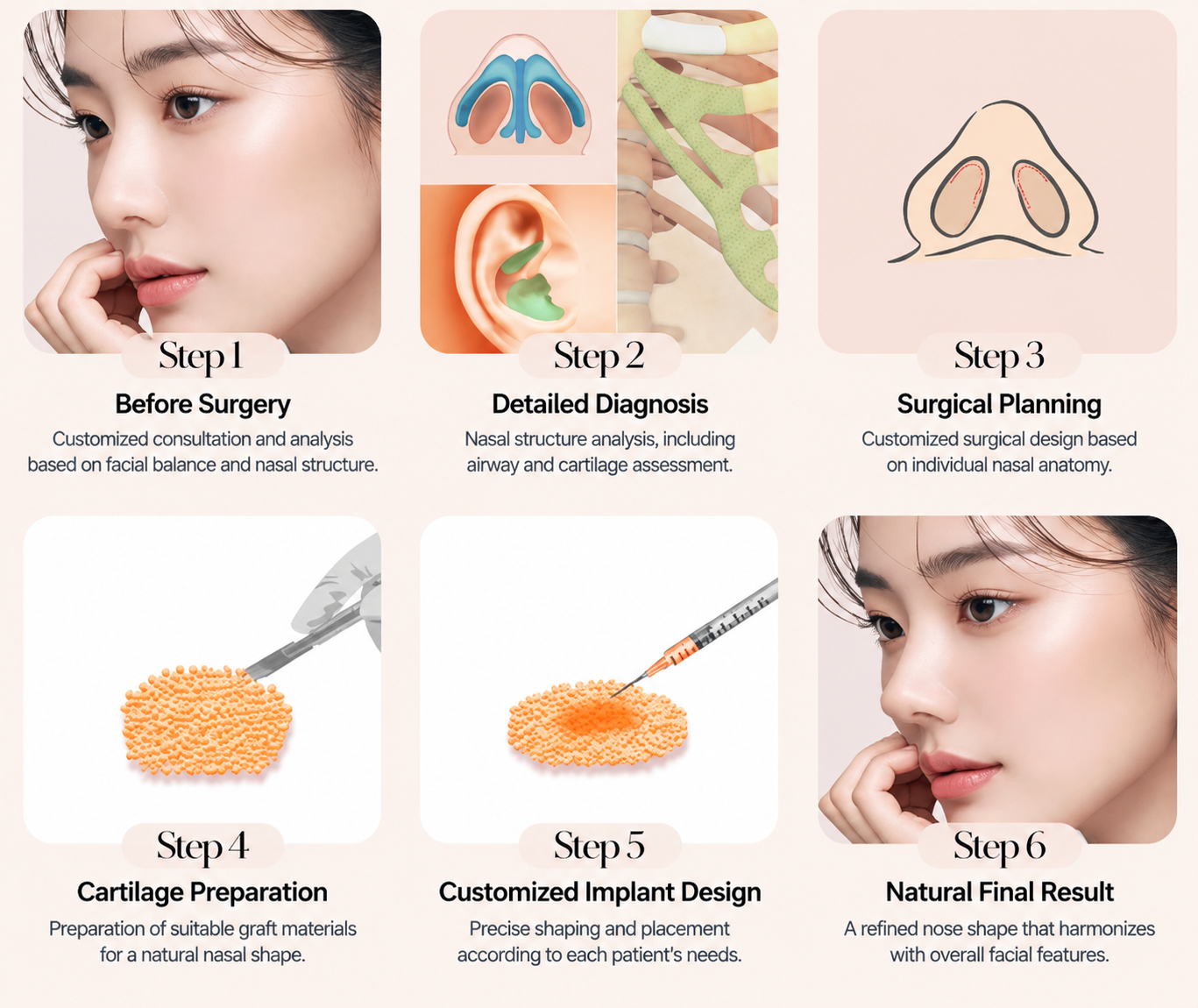
The consultation reviews your medical history, medications, allergies, previous nasal procedures and your goals, and examines nasal anatomy, skin characteristics, symmetry and — where relevant — breathing function. Realistic outcomes, alternatives, risks and the possibility of complications are discussed, informed consent is obtained, and baseline photographs are documented with your permission. The clinic identifies 3D-CT and high-resolution endoscopy as part of its assessment equipment, used when the case calls for it.
On the day, the nose is assessed and prepared, the treatment area is cleaned, the plan is set, the cartilage is processed and placed using the selected technique, and the immediate result is checked before aftercare instructions are given. Sleep anaesthesia is used throughout.
Stage | What the clinic states |
|---|---|
Procedure time | Tip techniques in this clinic's rhinoplasty range run approximately 1–3 hours |
Anaesthesia | Sleep anaesthesia (sedation) |
Flying home | Up to approximately 3 days, subject to the surgeon's assessment |
Stay in Korea | A personalised schedule from the clinic; the rhinoplasty programme generally plans 7–10 days |
Swelling | Decreases progressively over the following weeks and months |
Final contour | Nasal contour may continue refining for 12–18 months |
The gap between "fly home in about three days" and "plan 7–10 days" is not a contradiction so much as two different questions. The first is about whether air travel is safe; the second is about whether your follow-up appointments have happened yet. The clinic's position across its rhinoplasty work is that you should obtain the surgeon's approval before flying rather than working from a published figure, and that is the version to plan around.
Common temporary effects include swelling, bruising, nasal congestion, tenderness and changes in skin sensation. The clinic's documented risk list for this service covers both routes a tip procedure can take: for injectable approaches, swelling, bruising, redness, tenderness, infection, asymmetry, lumps or product displacement, and vascular occlusion — a serious risk of nasal filler injection that can lead to skin necrosis, visual impairment or blindness. For surgical approaches, the additional risks are bleeding, infection, scarring, anaesthesia complications and unsatisfactory results. Across the clinic's rhinoplasty work more broadly, cartilage grafts may resorb or shift, and revision surgery is possible.
The category carries its own baseline risks on top of those. The NHS notes that any operation also carries a small risk of excessive bleeding, a blood clot in a vein, infection, or an allergic reaction to the anaesthetic, and that nose reshaping can also occasionally result in permanent breathing difficulty, damage to the cartilage wall between the nostrils, an altered sense of smell, or heavy nosebleeds. None of those are specific to this clinic or this technique — they are what the operation is, anywhere.
Aftercare: keep the area clean, attend the recommended follow-up appointments, avoid unnecessary pressure or manipulation of the nose, and follow the surgeon's advice on exercise, heat and skincare. Severe pain, unusual skin discoloration, visual symptoms or rapidly worsening symptoms require immediate medical assessment rather than waiting for the next appointment.
For patients returning to the United States, the practical concerns the clinic hears are consistent: managing swelling and discomfort on a long-haul flight, protecting the nose during airport transfers, remote follow-up across time zones, and knowing how to find local care if something unexpected develops after arriving home. If something feels wrong after returning home, patients can reach the clinic's English-speaking counselling manager by phone or email. Arranging that line of contact before you fly is more useful than arranging it afterwards.
Combining Cell Fix™ Nose with Other Treatments
The clinic's position on combining this procedure is that possible combinations depend on the confirmed technique and the patient's anatomy, and that other facial aesthetic procedures should be considered only after assessing safety, treatment sequence and recovery. At the level of the rhinoplasty programme as a whole, the clinic states that procedures can combine bridge and tip reshaping with dermal grafting or facial lifting where appropriate.
What that means in practice is that a tip procedure is often not the whole plan. A patient concerned about the tip is frequently also concerned about the bridge, or about nostril width, and those are separate operations in this clinic's range — non-implant rhinoplasty for cartilage-based work from bridge through tip, closed rhinoplasty defined by its access route, alar reduction for the nostrils and nasal base, and nostril retraction correction for excessive nostril exposure. Whether any of them belongs in the same operation is a question about operating time, anaesthesia and recovery as much as about the nose.
Alternatives are also worth naming rather than assuming. Depending on your goals, the clinic lists observation, temporary cosmetic approaches such as makeup, approved non-surgical injectable treatments, or surgical rhinoplasty as the realistic options. Functional concerns — breathing rather than appearance — may call for assessment by an ENT specialist or facial plastic surgeon rather than a tip procedure. Revision and complex cases are assessed individually by Dr. Kim Ji Sun at consultation.
Safety, Precision, and Clinic Standards
Le.J Plastic Surgery is a Registered Medical Institution for Attracting Foreign Patients, certified by the Ministry of Health and Welfare in compliance with the Medical Overseas Expansion and Foreign Patients Attraction Act.
The clinic's stated safety process for nasal work begins with preoperative assessment of individual nasal anatomy, facial proportions and relevant functional concerns before any surgical planning. Diagnostic imaging — 3D CT and nasal endoscopy — is used when appropriate. Technique and material are selected for the patient rather than from a standard protocol, which for this procedure means the patient's own cartilage. Postoperative monitoring follows, and the clinic's recovery facilities include hyperbaric oxygen equipment.
The AAO-HNS Foundation's clinical practice guideline on improving nasal form and function after rhinoplasty is the category's own account of good practice, and is a reasonable yardstick when comparing surgeons in any country.
Le.J Plastic Surgery publishes neither case volumes nor complication rates for this procedure, and this page claims neither. It also publishes no exclusion list of its own. Both are fair questions at consultation, as is the one worth asking any surgeon in this category: how many of these operations they have performed, how many involved complications, and what follow-up to expect if something goes wrong.
The Bottom Line
Cell Fix™ Nose is a nasal-tip procedure using the patient's own finely processed cartilage, through a closed approach with no incision under the nose.
It addresses the tip. Bridge reshaping, nostril narrowing and functional breathing problems are different procedures.
It is performed under sleep anaesthesia by Dr. Kim Ji Sun, a board-certified otolaryngologist with 20 years of experience and 4,000+ clinical cases.
Tip techniques here run approximately 1–3 hours; the nasal contour can continue refining for 12–18 months.
Several fields in the clinic's own documentation for this service are left for the clinic to confirm, so technique specifics belong to the consultation.
Frequently Asked Questions
Is anything artificial placed in my nose? No. The material is your own cartilage, finely processed before it is placed in the tip. If you want bridge augmentation with an implant, that is a different procedure in the clinic's range, and the choice between them is made at consultation after examination.
Will there be a scar under my nose? Not from this procedure. It uses a closed approach, which means no incision is made across the columella under the nose. Patients who need an open approach for anatomical reasons would be told so during assessment.
How long does it take, and will I be asleep? Sleep anaesthesia — sedation — is used, so you remain relaxed and comfortable rather than fully unconscious or fully awake. For tip techniques the clinic's rhinoplasty range is approximately one to three hours, varying with complexity.
When can I fly home? The clinic's figure for this service is up to around three days, but that is about whether flying is safe, not whether your follow-up is finished. Across its rhinoplasty work the clinic asks patients to obtain the surgeon's approval before flying, and the wider programme plans 7–10 days in Korea. Ask for a personalised schedule before booking.
When will my nose look like the result? Not immediately. Swelling affects the appearance early on and decreases progressively over the following weeks and months, with the nasal contour continuing to refine for up to 12–18 months. Early photographs are not the result.
Can the cartilage be absorbed or move? Cartilage grafts can warp, resorb or shift over time — this is a known characteristic of autologous grafting across the clinic's nasal work rather than a complication unique to this procedure. Revision surgery is possible. It is worth discussing before surgery rather than discovering afterwards.
What should I tell the clinic beforehand? Your medical conditions, medications and supplements, allergies, smoking history, and every previous nasal procedure including injections. Follow the clinic's instructions on skin preparation and medication management, and do not stop prescribed medication without medical advice.
Book a Consultation at Le.J Plastic Surgery

Cell Fix™ Nose at Le.J Plastic Surgery in Gangnam, Seoul starts with an examination of your nasal anatomy and facial proportions, which is also where it is decided whether a tip procedure is the right answer at all. Consultations run Monday to Friday, 10:00–19:00 KST, and Saturday from 10:00 KST. International enquiries are handled by the clinic's counseling manager, Park Somi, and English-language support is available. If you are travelling from abroad, ask for a personalised schedule covering surgery and follow-up before booking flights. You can use the clinic's contact page, by phone on +82-2-516-7153, or by email at info@lejplasticsurgery.com.
Disclaimer
This page is for general information only and is not medical advice. Individual results vary and cannot be guaranteed. Suitability for any procedure can only be determined through an in-person medical consultation with a qualified doctor.
Sources & Further Reading
Ready for a Personalized 1:1 Consultation?
Dr. Kim Ji Sun personally conducts every consultation, surgical plan, and follow-up at Le.J Plastic Surgery in Gangnam, Seoul.