Personalized Rhinoplasty & Facial Aesthetics in Gangnam, Seoul · Tel: +82-2-6954-1988
en-US
CLINICAL PROCEDURE GUIDE
Non-Implant Rhinoplasty
Non-implant rhinoplasty at Le.J Plastic Surgery in Seoul reshapes the nose with the patient's own cartilage from bridge to tip, through a closed approach.

Non-Implant Rhinoplasty in Seoul at Le.J Plastic Surgery

Medically reviewed by Dr. Kim Ji Sun, M.D., M.S., Ph.D., Board-Certified Otolaryngologist · Le.J Plastic Surgery, Gangnam-gu, Seoul
Non-implant rhinoplasty reshapes the nose using the patient's own cartilage rather than an artificial implant. At Le.J Plastic Surgery in Gangnam, Seoul the stated technique uses autologous cartilage from the nasal bridge through the tip and is performed through a closed approach, without an incision beneath the nose. The surgical plan weighs nasal anatomy, facial proportions, appearance and nasal function together. Within the clinic's rhinoplasty range it is the structural, whole-nose option, and it is performed personally by Dr. Kim Ji Sun, the clinic's founder and Medical Director and the listed performing doctor for the parent Rhinoplasty specialty.
What Is Non-Implant Rhinoplasty?
Non-implant rhinoplasty is nasal reshaping that uses the patient's own cartilage as the structural material, with no artificial implant in the treated span.
The treated span runs from the nasal bridge through to the tip — this is a whole-nose structural procedure, not a tip-only one.
Cartilage sources are the patient's own septal, ear or costal (rib) cartilage, selected according to anatomy and surgical need.
The approach is closed: no incision is made beneath the nose.
Sedation anaesthesia, which the clinic also describes as sleep anaesthesia, is used.
The clinic states an approximate surgical duration of one hour.
The word "non-implant" describes what is absent, which can mislead. What is present is a cartilage-based reconstruction, and that brings its own considerations — a donor site, and graft material that behaves like living tissue over time rather than staying fixed. Implant-free surgery does not eliminate complications or guarantee a particular appearance, and the clinic says so directly in its own documentation.
Who Performs Non-Implant Rhinoplasty at Le.J Plastic Surgery

Dr. Kim Ji Sun, M.D., M.S., Ph.D.
Board-certified Otorhinolaryngologist
Non-implant rhinoplasty is performed personally by Dr. Kim Ji Sun, the clinic's founder and Medical Director and the listed performing doctor for the parent Rhinoplasty specialty.
Dr. Kim is a board-certified otolaryngologist who earned an M.D., a Master's degree and a Ph.D. from Dankook University College of Medicine, completed internship and residency at Dankook University Hospital, trained as a Clinical Fellow in the Department of Otorhinolaryngology at Asan Medical Center, and has served as a Guest Professor at Stanford University School of Medicine in the United States.
Dr. Kim served as Rhinoplasty Hands-on Course Director from 2020 to 2022 under the Korean Society of Facial Plastic and Reconstructive Surgery, was an invited speaker on functional rhinoplasty at the Seoul National University Hospital rhinoplasty workshop in 2021, and lectured on non-incisional rhinoplasty at the 11th KSFPRS educational course in 2025.
Le.J Plastic Surgery is a single-doctor clinic, so the surgeon who assesses your nose is the surgeon who operates on it. For a cartilage-based reconstruction that is more than a scheduling detail: how much cartilage is needed, which donor site it comes from, and how it is shaped are decisions made with the nose open on the table, and they follow from the assessment rather than from a catalogue.
Who Is a Good Candidate for Non-Implant Rhinoplasty?
Suitable candidates:
Patients seeking nasal reshaping or augmentation without an artificial implant who have suitable cartilage available.
Patients whose nasal anatomy, skin characteristics, facial proportions and functional needs support a cartilage-based reconstruction, with realistic expectations about what it can achieve.
Who should be assessed carefully or postpone:
Patients with active infections, uncontrolled medical conditions, or significant healing concerns.
Patients with unacceptable anaesthesia-related risks.
Patients with insufficient suitable cartilage. This is the constraint specific to this operation — the material has to come from somewhere, and if there is not enough of it, the technique changes.
Patients with unrealistic expectations.
Patients with previous nasal surgery, which requires medical evaluation before treatment rather than ruling the operation out.
The cartilage question deserves a sentence of its own, because it is the one that most often changes the plan. Septal cartilage is the nearest source but is finite, and a patient who has had previous nasal surgery may have less of it than expected. Ear cartilage and rib cartilage are the alternatives, each with its own donor site and its own recovery. None of this rules the operation out; it means the material decision and the suitability decision are the same decision, and it is made after examination rather than before.
Across its rhinoplasty work the clinic applies the general conditions too: completed facial growth, physically healthy, non-smoking. Obstructive sleep apnoea requires special consideration. The American Society of Plastic Surgeons lists the same conditions for the category, and adds a positive outlook with realistic goals.
What to Expect: Procedure, Recovery, and Results Timeline
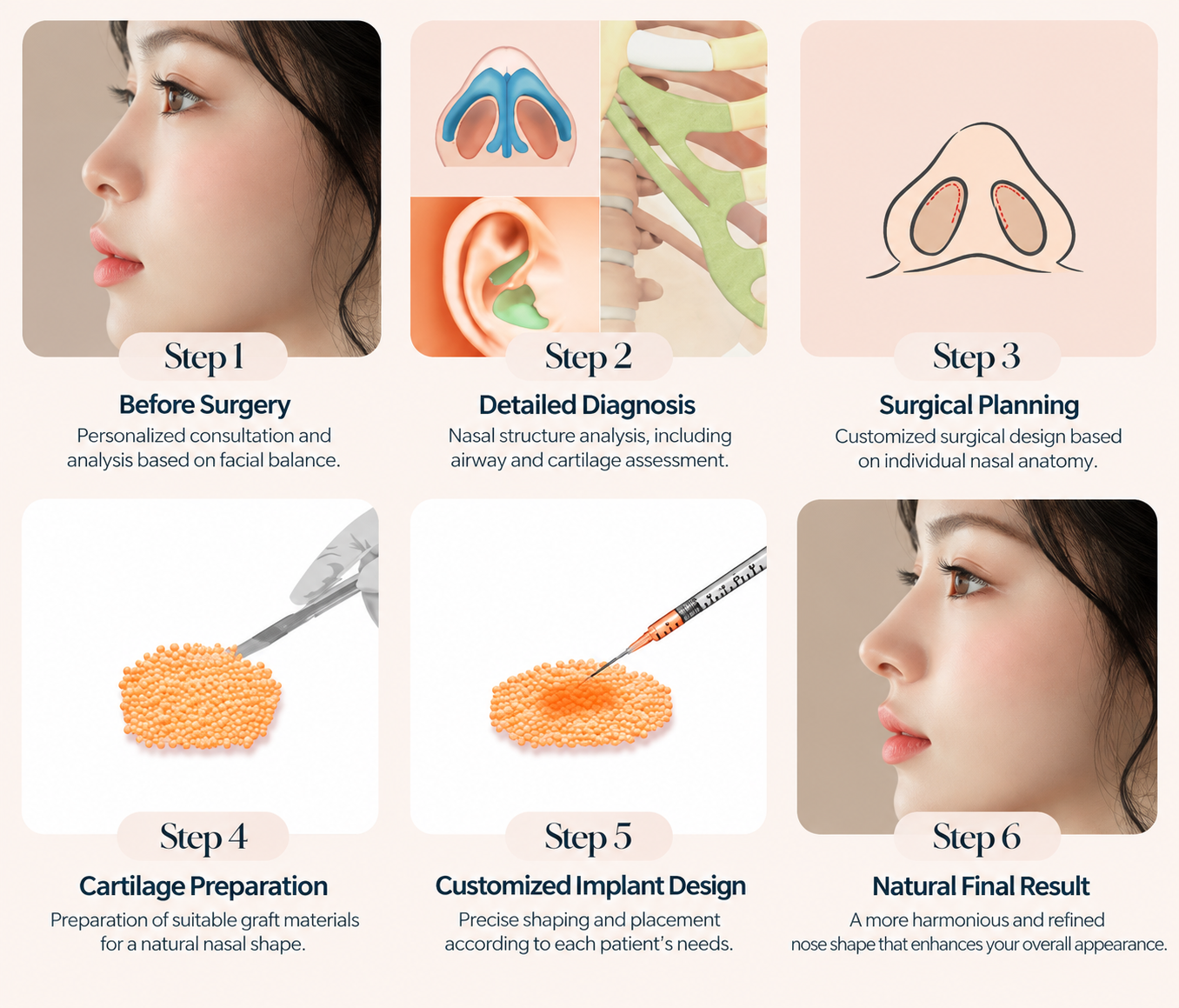
The consultation reviews medical history, previous nasal procedures, medications, supplements, breathing concerns and aesthetic goals, and evaluates nasal structure and facial proportions to plan the procedure. The clinic states that 3D CT scanning and endoscopy may be used when necessary to examine internal nasal structures and support surgical planning.
During surgery the surgeon assesses the nose, plans the intended contour, obtains suitable autologous cartilage where needed, prepares the graft material, and reshapes or supports the nasal structure — using cartilage from the bridge through the tip, through a closed approach without an incision beneath the nose. Exact steps depend on the individual case.
Stage | What the clinic states |
|---|---|
Surgical duration | Approximately 1 hour |
Anaesthesia | Sedation (sleep) anaesthesia |
Nasal taping | Removed after approximately 3 days |
Return to daily life | After the taping comes off |
Stitches | Removed at the cartilage-harvesting site after approximately 7 days |
Early visible change | After taping removal at around day 3, though swelling still affects the appearance |
Final refinement | Up to a year or longer |
Recovery in the clinic's own summary takes approximately three to seven days, with a return to daily activities once the taping is removed. That figure describes getting back to ordinary life, not the end of healing: swelling and tissue remodelling continue for several months, and final contour refinement may take up to a year or longer. Do not assume that removal of the nasal tape at 3 days means you are ready to fly. The clinic asks surgeons to confirm when flying is appropriate based on your recovery, examination findings and follow-up needs, and it recommends that international patients discuss the length of stay with the surgeon and allow enough time for the required follow-up.
Common temporary effects are swelling, bruising, nasal congestion, tenderness, and discomfort at the cartilage-harvesting site. Possible complications include bleeding, infection, asymmetry, contour irregularities, altered sensation, breathing problems, poor wound healing, scarring and possible revision surgery. Two risks belong to this technique in particular: cartilage grafts may warp, resorb or become displaced, and harvesting cartilage may cause pain or other donor-site complications.
The category's baseline risks sit underneath those. The NHS notes that any operation also carries a small risk of excessive bleeding, a blood clot in a vein, infection, or an allergic reaction to the anaesthetic, and that nose reshaping can also occasionally result in permanent breathing difficulty, damage to the cartilage wall between the nostrils, an altered sense of smell, or heavy nosebleeds.
Aftercare covers two sites rather than one: follow the instructions for protecting the nose, caring for the cartilage donor site, managing swelling, and attending postoperative appointments. Avoid pressure or trauma to the nose and resume exercise according to the surgeon's guidance. Seek prompt medical advice for worsening pain, fever, heavy bleeding, wound problems or new breathing difficulties.
For patients returning to the United States, the recurring practical concerns are managing swelling on a long flight, protecting the nose during airport transfers, and arranging follow-up across time zones. If something feels wrong after returning home, patients can reach the clinic's English-speaking counselling manager by phone or email.
Combining Non-Implant Rhinoplasty with Other Treatments
The clinic has not confirmed a combination protocol specific to this procedure. At programme level, the clinic states that procedures can combine bridge and tip reshaping with dermal grafting or facial lifting where appropriate, and combined surgery changes operating time, recovery and the length of stay.
The more useful comparison is within the clinic's own range, because the four nasal procedures divide along different axes and are easy to confuse. Non-implant rhinoplasty is defined by its material — autologous cartilage, bridge to tip. Cell Fix™ Nose is a nasal-tip procedure using finely processed autologous cartilage. Closed rhinoplasty is defined by its access route rather than by material. Alar reduction targets the nostrils and nasal base, and nostril retraction correction addresses excessive nostril exposure. Outside this clinic's range, implant-based rhinoplasty and non-surgical approaches are the other options, selected by goal and suitability. Revision and complex cases are assessed individually by Dr. Kim Ji Sun at consultation.
Safety, Precision, and Clinic Standards
Le.J Plastic Surgery is a Registered Medical Institution for Attracting Foreign Patients, certified by the Ministry of Health and Welfare in compliance with the Medical Overseas Expansion and Foreign Patients Attraction Act.
This is the one procedure in the clinic's nasal range for which it has documented a risk-reduction account rather than leaving the field for confirmation. The clinic describes using the patient's own cartilage from the nasal bridge through the tip and a closed technique without an incision beneath the nose; preoperative 3D CT scanning and nasal endoscopy when needed for assessment and surgical planning; and a postoperative care system that includes hyperbaric oxygen therapy equipment. Postoperative monitoring follows, and the clinic's recovery facilities include hyperbaric oxygen equipment.
The AAO-HNS Foundation's clinical practice guideline on improving nasal form and function after rhinoplasty is the category's own account of good practice, and is a reasonable yardstick when comparing surgeons in any country.
Le.J Plastic Surgery publishes neither case volumes nor complication rates for this procedure, and this page claims neither. It also publishes no exclusion list of its own. Both are fair questions at consultation, as is the one worth asking any surgeon in this category: how many of these operations they have performed, how many involved complications, and what follow-up to expect if something goes wrong.
The Bottom Line
Non-implant rhinoplasty reshapes the nose with the patient's own cartilage from bridge to tip, with no artificial implant in that span.
The approach is closed — no incision beneath the nose — and the clinic states an approximate surgical duration of one hour.
Cartilage comes from the septum, ear or rib, which means a donor site and its own recovery.
Taping comes off at about 3 days and donor-site stitches at about 7; final refinement may take up to a year or longer.
Grafted cartilage can warp or resorb over time. Avoiding an implant removes implant-specific risks, not all risks.
Frequently Asked Questions
Where does the cartilage come from? From your own body — septal cartilage from inside the nose, ear cartilage, or costal cartilage from a rib. Which source is used depends on your anatomy and on how much material the plan needs, and it is decided as part of the surgical assessment rather than chosen from a list.
Is this better than a silicone implant? It is different, not automatically better. Using your own tissue avoids implant-specific complications such as displacement, visibility or extrusion. It introduces a donor site, and grafted cartilage may warp or resorb over time. The clinic's own documentation states plainly that implant-free surgery does not eliminate complications or guarantee a particular appearance.
How long does the operation take? The clinic states approximately one hour, under sedation anaesthesia. That is the operating time; the appointment, preparation and recovery period around it are longer.
When can I go back to normal life, and when can I fly? Daily activities resume after the taping comes off at around day 3, and the clinic's recovery summary gives roughly three to seven days. Flying is a separate question with a separate answer — the clinic is explicit that taping removal at 3 days does not mean you are ready to fly, and asks the surgeon to confirm based on your recovery and follow-up needs. Donor-site stitches come out at about day 7, which is usually the binding constraint on a trip.
Will the shape change later? Some change is expected. Swelling and tissue remodelling continue for several months and final refinement may take up to a year or longer. Beyond that, cartilage grafts can warp or resorb, so the structure is intended to be long-lasting rather than guaranteed to be unchanged.
Does the rib or ear donor site hurt? Postoperative tenderness, swelling, congestion or discomfort at the cartilage donor site may occur, and harvesting cartilage may cause pain or other donor-site complications. Aftercare covers that site as well as the nose, and stitches there are removed at about day 7.
What should I tell the surgeon beforehand? Your complete medical history, including previous nasal surgery, breathing problems, allergies, medications, supplements, smoking and anaesthesia history. Follow the clinic's instructions on fasting, medication management and smoking. Do not stop prescribed medication without medical advice, and tell the clinic about any active infection or new health concern before surgery.
Book a Consultation at Le.J Plastic Surgery
Non-implant rhinoplasty at Le.J Plastic Surgery in Gangnam, Seoul begins with an assessment of nasal structure and facial proportions, and — for this procedure specifically — of whether suitable cartilage is available for the plan you want. Consultations run Monday to Friday, 10:00–19:00 KST, and Saturday from 10:00 KST. International enquiries are handled by the clinic's counseling manager, Park Somi, and English-language support is available. If you are travelling from abroad, plan around donor-site stitch removal at about day 7 rather than around taping removal at day 3. You can use the clinic's contact page, by phone on +82-2-516-7153, or by email at info@lejplasticsurgery.com.
Disclaimer
This page is for general information only and is not medical advice. Individual results vary and cannot be guaranteed. Suitability for any procedure can only be determined through an in-person medical consultation with a qualified doctor.
Sources & Further Reading
Ready for a Personalized 1:1 Consultation?
Dr. Kim Ji Sun personally conducts every consultation, surgical plan, and follow-up at Le.J Plastic Surgery in Gangnam, Seoul.