Personalized Rhinoplasty & Facial Aesthetics in Gangnam, Seoul · Tel: +82-2-6954-1988
en-US

MEDICAL ARTICLE & INSIGHTS
What Happens at a Rhinoplasty Consultation in Korea
Inside the rhinoplasty consultation process at Le.J Plastic Surgery: the anatomy exam, the breathing check, goal setting, and how a surgical plan is built.

What Happens During a Rhinoplasty Consultation: Anatomy, Function, and Goals
Medically reviewed by Dr. Kim Ji Sun, M.D., Ph.D., Board-Certified Otolaryngologist
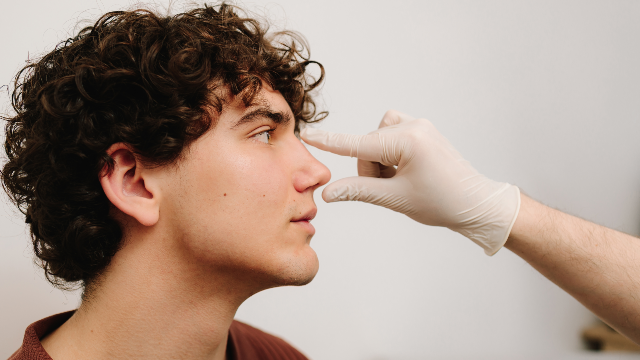
The rhinoplasty consultation process is where the operation is actually decided. Le.J Plastic Surgery in Seoul evaluates a patient's natural anatomical structure, current medical condition, functional factors, and individual characteristics, and only develops a detailed surgical plan after analyzing all four. That ordering matters: the plan follows the assessment rather than the other way around, which is why two people who arrive wanting "a smaller nose" can leave with very different operations on paper.
Four things the assessment looks at, and why none of them is optional
Le.J Plastic Surgery describes its consultation as an analysis of anatomical structure, medical condition, functional factors, and individual circumstances, followed by detailed surgical planning. Each of those carries weight in a different way.
Anatomical structure is the starting constraint. The nose is a layered construction of bone, cartilage, lining, muscle, and skin, and what can be changed depends on what is there to work with. Le.J Plastic Surgery states that its surgical planning considers facial proportions, three-dimensional appearance, and functional nasal factors together rather than treating them as separate questions.
Medical condition determines whether an elective operation is sensible at all right now. Functional factors cover breathing. Individual circumstances cover everything that makes a plan practical for a particular person — including, for an international patient, the shape of the trip itself.
The clinic operates a systematic safety system and evaluates both aesthetic satisfaction and functional aspects before surgery. Among the assessment tools it lists are three-dimensional CT imaging and high-resolution endoscopy, which allow the inside of the nose and the underlying bony framework to be examined rather than inferred from the outside.
Goals come before technique, not after
Le.J Plastic Surgery's pre-procedure review covers your surgical goals alongside your medical history, any previous nasal surgery or treatment, and any concerns you have about breathing. That sequence is deliberate.
The clinical literature is blunt about why. In its rhinoplasty chapter, StatPearls — a peer-reviewed reference hosted on the US National Library of Medicine's Bookshelf — argues that the priority at a first visit is to establish what the patient actually wants and whether it can be achieved, because postoperative satisfaction is the main measure of whether the surgery succeeded. The same chapter recommends discussing the specific features a patient dislikes, such as a dorsal hump, a deviation, or asymmetry at the tip, and then explaining systematically what can be improved and how.
It is also candid about the limits of judgment here. There is no proven method, StatPearls says, for reliably spotting in advance which patients will be unhappy afterward. Memorable acronyms have circulated for decades — SYLVIA for the profile thought to do well, SIMON for the profile thought to do poorly — but the same source presents them as rough guides rather than screening tools, which is the right way to read them.
Two cautions follow from that honesty. Psychiatric history is part of the conversation, and StatPearls specifically asks surgeons to recognize body dysmorphic disorder early, because symptoms can worsen after surgery and no validated instrument diagnoses it consistently. And prior nasal surgery is worth describing in detail, including how you found the experience, because it informs both the plan and what the new surgeon should promise.
The American Society of Plastic Surgeons frames the motivation question from the patient's side: rhinoplasty is a highly individualized procedure, and in its guidance for prospective patients the society says you should pursue it for yourself rather than to satisfy someone else or to match an ideal image. It also sets one expectation early — every face is asymmetric to some degree, so the aim is balance and proportion rather than perfect symmetry.
The photographs are not souvenirs
A standardized photographic series is part of a rhinoplasty assessment, and the standardization is the point. StatPearls describes positioning the head in the Frankfort horizontal plane — a line from the lower eye socket to the top of the ear canal held parallel to the floor — and capturing frontal, both profiles, both three-quarter views, the base view, and the dorsal view.
Why bother? Because a nose photographed at a slightly different head tilt looks like a different nose. Fix the plane and the before-and-after comparison means something. These images then serve as reference points during counseling and during the operation itself.
Photographs also make it easier to talk about what you are seeing. If you have been looking at your profile in your phone camera, it is worth knowing that a front-facing lens at arm's length distorts the nose relative to how people see you in a room.
Computer simulation is a separate question. A 2017 survey cited by StatPearls found that 63% of rhinoplasty surgeons used two- or three-dimensional simulation during consultations, and the same source notes the trade-off plainly: simulation helps some patients form realistic expectations, while others fixate on the simulated image and struggle to accept anything different. A surgeon who declines to use it is not being evasive.
The breathing questions are clinical, not small talk
Because function sits inside Le.J Plastic Surgery's assessment rather than beside it, expect the consultation to go into how your nose works.
The relevant history is specific: whether one side is worse than the other, whether obstruction gets worse on exertion or at night, whether you have had an injury, and whether you have ongoing sinus trouble or allergies. StatPearls lists obstructive sleep apnea, recurrent or chronic sinusitis, hypertension, and bleeding tendencies among the conditions worth raising before nasal surgery, since each can change the plan or require management first.

It also flags a small number of exposures that matter more than patients expect. Inhaled cocaine causes intense vasoconstriction and chronic inflammation of the nasal lining, and StatPearls advises that people actively using it should avoid elective nasal surgery, with healing impairment potentially persisting long after use stops. This is a question asked for surgical reasons, not moral ones.
MedlinePlus, the patient-education service of the US National Library of Medicine, lists relief of nasal breathing problems among the standard reasons rhinoplasty is performed, alongside changing the size of the nose, reshaping the tip or bridge, narrowing the nostril openings, and adjusting the angle between nose and upper lip. Knowing that list helps you name what you want.
Consent as a conversation, not a clipboard
A signature at the end is the smallest part of consent. A StatPearls review devoted to informed consent describes it as a process in which the clinician explains risks, benefits, and alternatives, and the patient participates actively in the decision — a standard traceable to a 1914 New York ruling that a person of sound mind has the right to decide what happens to their own body.
That review also names the failure mode: complex terminology and uneven health literacy can produce agreement without comprehension. Its recommended safeguard is the teach-back method, where you explain the plan in your own words and any gaps become visible. It is a technique clinicians use, and there is nothing stopping a patient from using it too.
The broader version of the idea is shared decision-making, which the same source describes as pairing the clinician's grasp of the evidence with the patient's own goals and circumstances, so the decision reflects both.
Planning a consultation from the United States
Le.J Plastic Surgery offers online consultation before travel, with English-language support for international patients, and its consultation covers its rhinoplasty services as well as its lifting and regenerative treatments. Postoperative consultation is also available through the clinic's consultation system.
For a US patient, the pre-travel conversation is where the awkward logistics get settled: what the plan is, what the recovery looks like, how follow-up works once you are home, and what to do if something concerns you after you land. You can open that conversation through the clinic's consultation page.
It is also reasonable to look at published results before you commit. Le.J Plastic Surgery maintains a before-and-after gallery sorted by category, which gives you concrete images to point at when you describe what you are hoping for — a far more useful starting point than an adjective. Background on the clinic's approach is available on its about-us page.
What to bring, and what to ask
Come with your medical history, a list of what you take, the story of any previous nasal procedure, and a clear description of what bothers you. Come with questions.
The American Academy of Dermatology, writing about cosmetic treatment generally, suggests two questions to put to yourself before any consultation: what you want to get out of the procedure, and how much downtime and risk you are prepared to accept. Both are worth answering before you walk in, because both shape what the surgeon can offer you.
The Bottom Line
- Le.J Plastic Surgery's consultation analyzes anatomical structure, medical condition, functional factors, and individual circumstances, and the surgical plan is written afterward.
- Facial proportions, three-dimensional appearance, and nasal function are considered together in planning, and three-dimensional CT and high-resolution endoscopy are among the tools the clinic lists.
- Goals are established before technique is chosen, because patient satisfaction is the primary measure of a successful rhinoplasty.
- Standardized photography in a fixed head position is part of the assessment and gives before-and-after comparison its meaning.
- Consent is a process built on comprehension, not a form signed at the end; the teach-back method is a practical way to check your own understanding.
Frequently Asked Questions
How long does a rhinoplasty consultation take?
The duration varies with the complexity of the case, so confirm the schedule with the clinic when you book. What is fixed is the content: Le.J Plastic Surgery evaluates anatomical structure, medical condition, functional factors, and individual characteristics, then builds the surgical plan from that analysis.
Will my breathing be assessed even if I am only concerned about appearance?
Yes. Le.J Plastic Surgery's rhinoplasty planning considers nasal function alongside facial proportions and three-dimensional appearance, and its pre-procedure review specifically covers breathing concerns.
Can I have a consultation before traveling to Korea?
Yes. The clinic offers online consultation before travel, with English-language support for international patients, so candidacy and planning can be discussed while you are still at home.
What should I tell the clinic about previous nose surgery?
Everything you can recall, including what was done, when, and how you found the result. Le.J Plastic Surgery's pre-procedure review covers previous nasal surgery or treatment, and StatPearls notes that a patient's account of an earlier operation informs both the new plan and the expectations set around it.
Are photographs taken at the consultation?
A standardized photographic series is part of a rhinoplasty assessment. StatPearls describes a fixed head position and a defined set of views, which keeps later comparison consistent and gives the surgeon reference points for planning.
What happens after the consultation, once I have gone home?
Postoperative consultation is available through Le.J Plastic Surgery's consultation system, and the clinic describes care that extends from consultation through surgery and recovery with ongoing observation.
Is a consultation a commitment to surgery?
No. Consent is a process of understanding risks, benefits, and alternatives, and the American Society of Plastic Surgeons is explicit that rhinoplasty should be pursued for your own reasons rather than anyone else's.
This article is for general informational purposes and does not constitute individualized medical advice. It is not a self-diagnosis tool. Surgical candidacy, technique, and expected outcomes can only be determined through a consultation with a qualified surgeon.
References
- StatPearls: Rhinoplasty
- StatPearls: Informed Consent
- MedlinePlus: Rhinoplasty
- ASPS: Rhinoplasty Candidates
- ASPS: Rhinoplasty
- AAD: Questions to Ask Before a Cosmetic Treatment
Ready for a Personalized 1:1 Consultation?
Dr. Kim Ji Sun personally conducts every consultation, surgical plan, and follow-up at Le.J Plastic Surgery in Gangnam, Seoul.