Personalized Rhinoplasty & Facial Aesthetics in Gangnam, Seoul · Tel: +82-2-6954-1988
en-US

MEDICAL ARTICLE & INSIGHTS
Revision Rhinoplasty: What Can Realistically Be Fixed
Revision rhinoplasty in Korea: how a second operation is assessed, why available tissue sets the limits, and what can and cannot be promised beforehand.

Revision Rhinoplasty: What Can and Cannot Be Corrected After a Previous Nose Job
Medically reviewed by Dr. Kim Ji Sun, M.D., Ph.D., Board-Certified Otolaryngologist
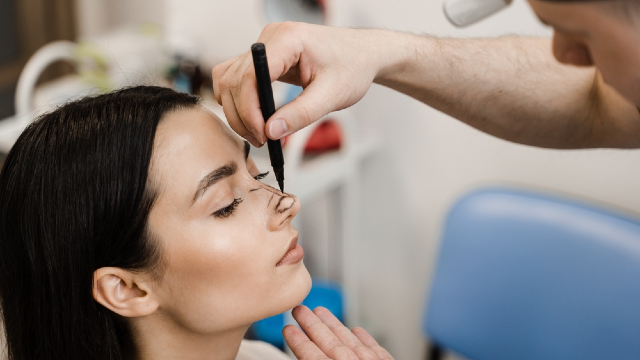
People considering revision rhinoplasty in Korea usually arrive with a sharper question than first-time patients do: not "what could my nose look like" but "can this specific thing be undone". At Le.J Plastic Surgery in Seoul, revision and complex cases are assessed individually by Dr. Kim Ji Sun during consultation, who reviews the patient's prior surgical or treatment history and the tissue that remains available before recommending an approach. The answer, in other words, is produced by an examination rather than by a policy.
Why a second operation is a harder problem than the first
A primary rhinoplasty works on anatomy that has never been disturbed. A revision works on anatomy that has been cut, sutured, sometimes reduced, and then healed for months or years.
StatPearls, the peer-reviewed clinical reference published through the US National Library of Medicine, puts the planning difficulty directly: while it is already hard to identify who will do well from a first rhinoplasty, deciding who will benefit from a revision is more complex still. Part of that is psychological — these patients' expectations have been shaped by an experience they have already had, which can cut either way. Part of it is biological. The same source notes that healing varies for the same patient between operations, so the way your nose behaved the first time is not a reliable forecast of how it will behave the second.
There is a related observation worth absorbing before you book anything. A result that looks excellent at the first postoperative visit, StatPearls says, may not still look that way a year later, or five, ten, or twenty years on. Noses keep moving.
What the clinic does when a revision case arrives
Le.J Plastic Surgery's stated approach to revision and complex cases is individual assessment during consultation, covering prior surgical or treatment history and available tissue, with the recommended approach following from that. The clinic does not work from a separate standardized revision protocol; the consultation is the protocol.
That is less evasive than it sounds. Two people describing the same complaint — a tip that looks pinched, a bridge that feels too low — can have entirely different amounts of cartilage left, entirely different scar patterns, and entirely different breathing. A fixed protocol would have to ignore the very things that determine the answer.
The general framework is the clinic's usual one: analysis of anatomical structure, medical condition, functional factors, and individual circumstances, followed by detailed surgical planning. Among the assessment tools it lists are three-dimensional CT imaging and high-resolution endoscopy, which matter more in a revision than in a primary case, because what happened inside the nose is exactly what you cannot see from outside.
Available tissue is the constraint that decides most of it
If one factor deserves to be understood before a revision consultation, it is this one.
Rhinoplasty rebuilds shape using structural support, and in a nose that has already been operated on, the septal cartilage most surgeons would reach for first may be partly gone. StatPearls addresses this in its consent guidance: patients undergoing revision surgery, along with those needing reconstruction after trauma or cancer, should also consent to tissue being harvested from outside the nose — cartilage from the ear, cartilage from the rib, or fascia from the temple — and the risks attached to those harvests should be discussed as part of the same conversation.
Le.J Plastic Surgery's own non-implant rhinoplasty uses the patient's own cartilage from the bridge through the tip rather than an implant, and its closed rhinoplasty is performed without an incision underneath the nose. Whether either is available to a particular revision patient is a question about that patient's remaining tissue, and it is answered at the examination.
What tends to be correctable
Several of the commonest revision complaints are structural, which is generally good news.
The nasal tip is the single most frequent source. Writing specifically on tip surgery, StatPearls notes that poor tip appearance or poor tip function is a common reason dissatisfied patients seek a secondary operation — and that the underlying anatomy, the paired lower cartilages, is well described and reachable.
Breathing problems that appeared after a first operation are also addressable in principle. StatPearls lists nasal obstruction after rhinoplasty as typically arising from collapse of the internal valve or from septal deviation, both of which are structural findings rather than vague ones. The American Society of Plastic Surgeons makes the corresponding patient-facing point: surgery intended to improve an obstructed airway requires careful evaluation of nasal structure in relation to airflow, and correcting a deviated septum, one of the most common causes of impaired breathing, is done by bringing the structure into better alignment.
Excessive nostril exposure that makes the nose look permanently lifted is a recognized post-surgical problem, and Le.J Plastic Surgery offers Nostril Retraction Correction for exactly that appearance, using alar surgery with dermal grafting added when coverage is needed.
MedlinePlus, the patient-education service of the US National Library of Medicine, adds a practical detail about access: an incision made outside the nose, around its base, is the one often used when work is needed on the tip or when a revision is being performed.
What is harder to promise
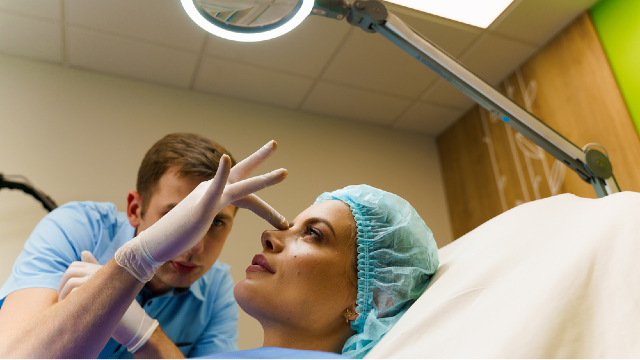
Some limits are worth hearing plainly.
Symmetry is the first. Every face is asymmetric to some degree, the American Society of Plastic Surgeons reminds prospective patients, so the goal is balance and proportion rather than a mirror image — and that is at least as true the second time, when scarring is unevenly distributed.
Scar tissue itself is the second. It is not a material a surgeon can specify; it is whatever formed, wherever it formed, and it behaves differently from the tissue it replaced.
Third, a revision can create its own problems. MedlinePlus lists loss of nasal support, contour deformities, worsening of breathing, and the need for further surgery among rhinoplasty's risks. StatPearls sorts complications into functional, aesthetic, hemorrhagic, infectious, and traumatic categories, and observes that in the long run it is the functional and especially the aesthetic ones that cause patients the most distress.
Fourth, no operation resolves dissatisfaction that is not really about the nose. StatPearls asks surgeons to recognize body dysmorphic disorder early in the process, notes that no validated instrument diagnoses it reliably, and records that patients with pre-existing psychiatric conditions face a higher risk of dissatisfaction and of depression after surgery.
Timing: when the first result is actually final
Patients often want a revision at the point where they are most unhappy, which is rarely the point where the picture is complete. Swelling is still resolving, tissues are still settling, and a nose judged too early is being judged against an interim state.
Waiting a full twelve months before deciding is the conventional clinical position, and it is not merely a delaying tactic — it is the difference between operating on a result and operating on a stage. According to Le.J Plastic Surgery, the appearance of the nose emerges gradually while swelling clears, and refinement carries on past the first anniversary of the operation.
Use the waiting period. Photograph the same views in the same light every month. Write down what specifically bothers you rather than relying on recollection, which drifts.
If your first operation was somewhere else
Bring what you have. StatPearls advises that eliciting a history of prior nasal surgery — including the patient's experience of it and of the previous surgeon — informs both the operative plan and the expectations set for patient and new surgeon alike.
That means operative notes if you can obtain them, the date, what you were told was done, what was used, and honest detail about how recovery went. Le.J Plastic Surgery's pre-procedure review already covers previous nasal surgery or treatment, medical history, breathing concerns, and your goals, and a revision consultation leans on all four.
MedlinePlus's general guidance after any operation is also worth borrowing here: ask what side effects to expect, what restrictions apply, and when normal activity resumes, since complications are unplanned events and knowing the expected course is what makes an unplanned one visible.
Arranging a revision consultation from the United States
Online consultation before travel is available with English-language support, which matters more for revision than for primary surgery: there is more history to convey and more uncertainty to settle before a flight is booked. Open that conversation through the clinic's consultation page.
Le.J Plastic Surgery's published results gallery is organized by category and includes a nose revision section, which is a reasonable way to calibrate the scale of change these operations produce. For background on how the clinic describes its own approach, see its about-us page.
The Bottom Line
- Le.J Plastic Surgery assesses revision and complex cases individually, reviewing prior surgical history and available tissue before recommending an approach.
- Deciding who benefits from a revision is clinically harder than deciding who benefits from a first operation, and healing differs between a patient's own surgeries.
- Remaining cartilage is the practical constraint; consent for a revision may include harvesting cartilage or fascia from outside the nose.
- Tip appearance, tip function, and post-surgical breathing obstruction are among the commonest and most structurally addressable complaints.
- Judge the first result only after a full year, and bring operative details from the original surgery to the consultation.
Frequently Asked Questions
Can Le.J Plastic Surgery correct a result from another clinic?
Revision and complex cases are assessed individually by Dr. Kim Ji Sun during consultation, who reviews the prior surgical or treatment history and the tissue still available before recommending an approach.
How long should I wait after my first rhinoplasty?
A full year is the conventional point at which a result can be judged fairly. The clinic describes the shape emerging progressively while swelling clears, with refinement continuing past the first anniversary, so an earlier assessment is measuring an intermediate stage.
What if there is not enough cartilage left in my nose?
Cartilage can be taken from outside the nose. StatPearls states that revision patients should consent to harvest from extranasal sites including the ear, the rib, and the temple region, with the risks of those harvests discussed beforehand.
Can breathing that got worse after surgery be improved?
It is a structural problem with structural causes. StatPearls attributes post-rhinoplasty obstruction chiefly to internal valve collapse or septal deviation, and the American Society of Plastic Surgeons describes septal correction as a standard route to better alignment and airflow.
Is a revision more likely to need another revision afterward?
Further surgery appears on MedlinePlus's list of rhinoplasty risks for any nasal operation, and StatPearls notes that healing varies between a patient's own operations. That uncertainty is part of what an individual assessment is trying to reduce.
What should I bring to a revision consultation?
Operative records if you can get them, the date of the original surgery, what you were told was done, and a specific written account of what bothers you now. The clinic's pre-procedure review covers previous nasal surgery or treatment, medical history, goals, and breathing concerns.
Will my nose be symmetrical afterward?
Balance and proportion are the realistic aim. No face is perfectly even to begin with, the American Society of Plastic Surgeons points out, so a completely symmetric outcome is not what the operation is promising — and scarring left unevenly by a previous procedure adds to that.
This article is for general informational purposes and does not constitute individualized medical advice. It is not a self-diagnosis tool. Surgical candidacy, technique, and expected outcomes can only be determined through a consultation with a qualified surgeon.
References
- StatPearls: Rhinoplasty
- StatPearls: Rhinoplasty Tip-Shaping Surgery
- MedlinePlus: Rhinoplasty
- ASPS: Rhinoplasty
- MedlinePlus: After Surgery
Ready for a Personalized 1:1 Consultation?
Dr. Kim Ji Sun personally conducts every consultation, surgical plan, and follow-up at Le.J Plastic Surgery in Gangnam, Seoul.