Personalized Rhinoplasty & Facial Aesthetics in Gangnam, Seoul · Tel: +82-2-6954-1988
en-US

MEDICAL ARTICLE & INSIGHTS
Non-Surgical vs Surgical Facial Lifting: How to Choose
Non-surgical vs surgical face lift: what skin elasticity decides, when a device is the right answer, and when only surgery reaches the deeper layer.
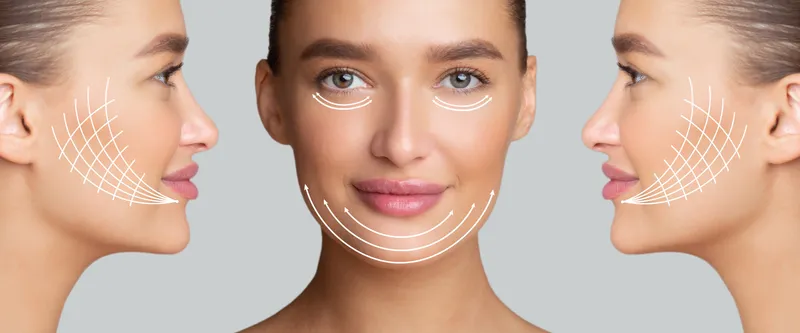
Non-Surgical vs Surgical Facial Lifting: How to Decide Which Approach Fits Your Skin
Medically reviewed by Dr. Kim Ji Sun, M.D., Ph.D., Board-Certified Otolaryngologist
The non-surgical vs surgical face lift question is usually framed as a choice between two products. It is better understood as a question about which layer of the face has changed. Le.J Plastic Surgery in Seoul offers both routes — a surgical forehead lift alongside a menu of device-based treatments — and states plainly that non-surgical options can improve skin quality and may complement or delay the need for surgical lifting. That sentence contains the whole decision: complement, delay, or replace are three different relationships, and only one of them is a substitute.
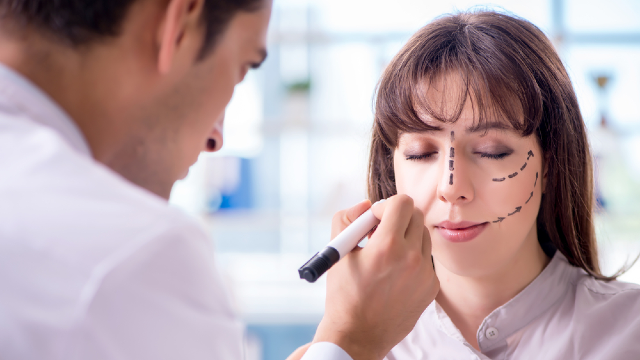
Aging happens in more than one layer
Skin change and structural change are not the same event, and they do not respond to the same tools.
MedlinePlus, the patient-education service of the US National Library of Medicine, describes the surface half: with age the skin thins, loses fat, and becomes less plump and smooth, with age spots and dryness appearing, and it takes longer to heal than it once did. That last point is easy to skip past and matters a great deal here, because slower healing is one of the things a surgical route has to account for.
Underneath that, something mechanical is happening. StatPearls, the clinical reference published through the US National Library of Medicine, catalogs the deeper changes that lead patients toward surgery: soft tissues descending under gravity, ligaments loosening, skin becoming redundant, fat atrophying, and bone gradually resorbing. The visible results it names are deep folds from nose to mouth, jowls, marionette lines, and banding of the neck, together with hollowing at the temples, around the mouth, and across the cheekbones.
A device that acts on skin quality does not reposition a descended soft-tissue layer. An operation that repositions soft tissue does not improve pigmentation or texture. Knowing which problem you have is most of the work.
Where Le.J Plastic Surgery draws the line
The clinic's own candidacy statement for facelift surgery is short and informative: healthy adults with visible facial aging, realistic expectations, and sufficient skin elasticity may be suitable candidates. Skin elasticity is the operative phrase — it is a property of your tissue, not a preference you bring.
Its non-surgical menu is presented as a different kind of answer: injectable treatments, laser and light treatments, chemical peels, and other skin-rejuvenation procedures, which improve skin quality and may complement or delay surgical lifting. Le.J Plastic Surgery's named device treatments sit in this group — Ultherapy, Thermage, Titanium, and Ulfacial — alongside its surgical Fore-fting forehead lift.
The clinic follows a personalized facial approach based on individual anatomical differences instead of one standardized facial design, and describes planning that weighs both aesthetic and functional considerations.
The American position on substitution
Patients reasonably want to know whether enough non-surgical sessions eventually equal an operation. The American Society of Plastic Surgeons answers that directly in its facelift guidance: a facelift can only be performed surgically, and minimally invasive rejuvenation treatments cannot achieve the same results — though they may help delay the point at which a facelift becomes appropriate, and may complement surgical results afterward.
The same guidance is equally firm about the other direction. A facelift is restorative rather than transformative: it does not change your fundamental appearance, and it does not stop the aging process.
Both halves are useful. The first stops you spending years on the wrong tool. The second stops you expecting the right tool to do something it was never going to do.
When surgery is the answer the anatomy is pointing at
The clinical indications are specific enough to be worth knowing.
StatPearls describes rhytidectomy — the surgical facelift — as one of several treatment options for an aging face, used to reposition soft tissues that have descended and to reduce excess skin, with the choice of technique guided by the patient's goals, their individual anatomy, and the surgeon's experience. Its examples map severity to approach: jowling or neck sagging with or without banding of the neck muscle is addressed by one family of techniques; deep folds from nose to mouth or significant descent of cheek fat point toward deeper-plane surgery; thicker skin and heavier soft tissues need more substantial techniques to give a satisfactory result.
It also describes a lighter-touch surgical option for people with more limited aging, performed through shorter incisions, sometimes under local anesthesia, with faster recovery — and notes that patients choosing this route are typically in their forties.
That detail is the one to hold onto. There is no single threshold at which non-surgical stops and surgical starts; there is a sequence of increasingly structural answers to increasingly structural problems.
When a device is the right answer
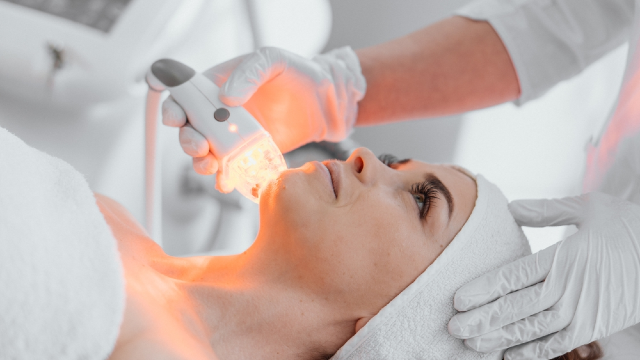
Skin that is textured, pigmented, sun-damaged, or simply looser than it was, on a face whose underlying structures have not meaningfully moved, is a skin problem.
The American Society of Plastic Surgeons describes the available approaches for that — laser and light treatments, chemical peels, mechanical resurfacing, injectables — as addressing textural irregularity, pigmentation change, and loss of firmness, and makes two points patients tend to skip. Most of these treatments require a series rather than one appointment, and a combination of methods usually outperforms any single one. And the durability of any result depends on the patient committing to protect the skin afterward.
Le.J Plastic Surgery's facelift guidance echoes the sequencing idea from the surgical side: non-surgical rejuvenation can improve skin quality and may delay the point at which surgery becomes the appropriate option.
Recovery is where the two routes differ most
Comparison charts tend to focus on results. The bigger practical difference is what the weeks afterward look like, and this is where a decision often resolves itself.
Le.J Plastic Surgery describes the recovery from facial lifting surgery in concrete terms: bruising and swelling commonly last about two to three weeks, many people return to work within two to three weeks of a traditional facelift, and the face can take two to three months to feel fully back to normal. Visible improvement appears as the bruising and swelling subside, and the results are long-lasting, though the face continues to age naturally afterward.
Set that against a device treatment delivered in a series of appointments, and the two routes are asking for very different things from your calendar and your tolerance. Neither requirement is a drawback in itself — but one of them has to fit your life.
What rules people out, and why it is worth knowing early
Both routes have exclusions, and the surgical ones are stricter.
Le.J Plastic Surgery states that people with conditions that interfere with healing or increase surgical risk, smokers, and people with unrealistic expectations may not be suitable candidates for facial lifting surgery, and that uncontrolled medical conditions and blood-thinning medication can increase the risk of complications. The American Society of Plastic Surgeons lists good candidates in nearly the same terms: healthy people without healing-impairing conditions, nonsmokers, and people with a positive outlook and realistic expectations.
StatPearls goes further into why. Diabetes, immune compromise, long-term steroid use, bleeding tendencies, and connective tissue disorders all impede wound healing. Smoking is singled out as a major risk factor for death of the skin flap because of its effect on blood supply. Weight that is expected to change is a relative contraindication, since later weight loss can bring laxity back and weight gain can return jowling. A tendency to thick or keloid scarring makes someone a less suitable candidate. And bleeding disorders, blood thinners, and uncontrolled high blood pressure all raise the risk of a hematoma, already among the commoner complications of the operation.
It also names a non-physical exclusion: preoperative assessment of psychiatric history is treated as essential to understand a patient's motivation, with referral to a mental health professional where body dysmorphic disorder is suspected.
How to hold the conversation
Dermatologists writing for the American Academy of Dermatology recommend settling two things privately before booking any cosmetic consultation — your actual objective, and your appetite for recovery time and risk. Those two answers do more to narrow the field than any comparison chart, because surgical and non-surgical routes differ far more in recovery and risk than in the vocabulary used to sell them.
Then bring the question to someone who can examine the tissue. StatPearls' summary of facelift practice is that each case is individual, that outcomes depend on patient selection as much as on technique, and that adjuvant treatments should be considered at the initial consultation rather than bolted on later — which is an argument for discussing the whole menu in one conversation rather than shopping for one item.
Le.J Plastic Surgery's assessment covers anatomical structure, medical condition, functional factors, and individual circumstances before a plan is written. You can begin that from home through the clinic's consultation page, and its published results gallery separates lifting cases by category, which helps calibrate what each route actually changes.
The Bottom Line
- Le.J Plastic Surgery states that non-surgical options can improve skin quality and may complement or delay the need for surgical lifting — they are a different answer, not a weaker version of the same one.
- Sufficient skin elasticity appears in the clinic's own facelift candidacy criteria, alongside general health and realistic expectations.
- A facelift can only be performed surgically, and it does not change your fundamental appearance or stop aging.
- Surgical technique is matched to how structural the problem is, from shorter-incision approaches for limited aging to deeper-plane surgery for significant descent.
- Smoking, blood thinners, uncontrolled medical conditions, and unstable weight all bear on whether surgery is advisable, and are worth raising at the first consultation.
Frequently Asked Questions
Can enough non-surgical treatments replace a facelift?
No. The American Society of Plastic Surgeons states that a facelift can only be performed surgically and that minimally invasive treatments cannot achieve the same results, while adding that they may delay the point at which surgery becomes appropriate and may complement its results.
How do I know whether my problem is skin or structure?
By examination. Le.J Plastic Surgery analyzes facial structure individually, considering both aesthetic and functional aspects, and plans treatment around each person's facial anatomy and desired appearance.
What does "sufficient skin elasticity" mean in practice?
It is a property of your tissue that an examination assesses. Le.J Plastic Surgery lists it among the criteria for facelift candidacy, together with visible facial aging, general health, and realistic expectations.
Does smoking matter if I am only considering non-surgical treatment?
It matters for your skin either way. MedlinePlus records that cigarette smoking contributes to wrinkling, with the effect increasing according to how much and how long a person has smoked. For surgery it matters considerably more: StatPearls identifies smoking as a major risk factor for skin flap death because of its effect on perfusion.
Will one device session be enough?
Usually not. The American Society of Plastic Surgeons notes that most skin treatments require a series of treatments and that combining methods works better than relying on a single one, with lasting results depending on continued skin protection.
Which of Le.J Plastic Surgery's treatments are surgical?
Fore-fting, the forehead lift, is the surgical lifting procedure. Ultherapy, Thermage, Titanium, and Ulfacial are device-based treatments on the non-surgical side of the menu.
Should I discuss both routes in the same consultation?
Yes, and the clinical literature supports it. StatPearls advises that adjuvant treatments be considered at the initial consultation rather than afterward, so the plan is built as a whole.
This article is for general informational purposes and does not constitute individualized medical advice. It is not a self-diagnosis tool. Surgical candidacy, technique, and expected outcomes can only be determined through a consultation with a qualified surgeon.
References
- StatPearls: Cervicofacial Rhytidectomy
- ASPS: Facelift Surgery
- ASPS: Facelift Candidates
- ASPS: Skin Rejuvenation and Resurfacing
- MedlinePlus: Skin Aging
- AAD: Questions to Ask Before a Cosmetic Treatment
Ready for a Personalized 1:1 Consultation?
Dr. Kim Ji Sun personally conducts every consultation, surgical plan, and follow-up at Le.J Plastic Surgery in Gangnam, Seoul.