Personalized Rhinoplasty & Facial Aesthetics in Gangnam, Seoul · Tel: +82-2-6954-1988
en-US

MEDICAL ARTICLE & INSIGHTS
Nasal Swelling After Rhinoplasty: What the First Year Holds
Nasal swelling after rhinoplasty follows a long course. What is normal through the first year, why the tip settles last, and when to raise a concern early.

Understanding Nasal Swelling After Rhinoplasty: What's Normal in the First Year
Medically reviewed by Dr. Kim Ji Sun, M.D., Ph.D., Board-Certified Otolaryngologist
Nasal swelling after rhinoplasty does not resolve on the schedule most patients assume. The bulk of it goes early, and then a smaller, stubborn remainder takes months to disappear — which is why a nose can look finished at six weeks and still be changing at ten months. Le.J Plastic Surgery in Seoul describes swelling decreasing progressively while the nasal contour continues to refine, and understanding that shape in advance is what keeps the first year tolerable.
Why a nose swells the way it does
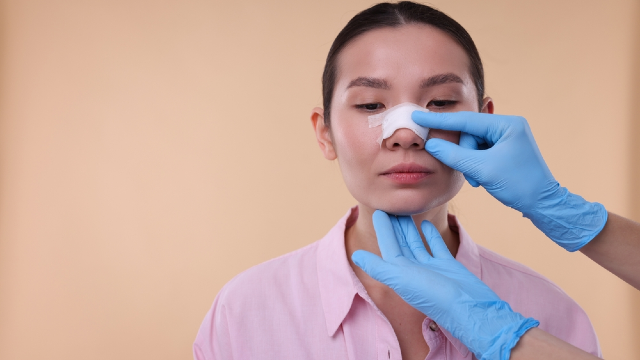
Swelling after surgery is not an accident of the operation; it is part of how tissue repairs itself.
A StatPearls review on the National Library of Medicine's Bookshelf traces the sequence in its account of how wounds heal. An injury first produces an outpouring of fluid and blood while bleeding is brought under control. Vessels narrow briefly, then widen, allowing white cells and platelets to flood the area. Mediators released from platelets, including serotonin and histamine, increase the permeability of cells, so fluid moves into the tissue. That influx is what a patient experiences as swelling.
The nose is unusually good at showing it. The skin and soft tissue over the nasal framework sit in a confined space with rich blood supply, and the underlying structure has just been altered. StatPearls also notes that tissue swelling is among the local factors that can slow healing, which is one reason surgeons ask patients to keep the head elevated in the early days rather than treating it as optional advice.
The first fortnight: most of it goes
The steepest improvement happens early.
Le.J Plastic Surgery describes the first week after nasal surgery as generally involving swelling, congestion, bruising, and restrictions on activity, and states that by around two to three weeks much of the visible bruising and early swelling may have improved. Initial swelling decreases over the first few weeks.
This is the phase people plan for, and it is also the phase they mistake for the whole process. What is gone by the end of the second week is the dramatic swelling. What remains is a quieter, more persistent fluid that is not obvious in a mirror from a conversational distance but is entirely obvious to the person who owns the nose.
Months one to three: the change slows down
Between the first month and the third, the rate of improvement drops sharply while improvement itself continues.
The American Society of Plastic Surgeons describes the arc in its rhinoplasty recovery guidance: initial swelling subsides within a few weeks, while the new nasal contour may take up to a year to refine fully, with gradual changes in appearance along the way toward a more permanent outcome.
Le.J Plastic Surgery frames the same period in terms of what should not yet be concluded. The clinic states that swelling and tissue remodeling can continue for several weeks or months after rhinoplasty, and that an early return to normal activities should not be read as complete healing.
Photographs taken in this stretch are a poor guide, and comparing them week to week tends to make the process feel stalled when it is not.
Months three to twelve: the part nobody warns you about
Residual swelling in the later months has a characteristic that surprises almost everyone, and it is documented rather than anecdotal.
The American Society of Plastic Surgeons notes that swelling may come and go, and may be worse in the morning, during the first year after rhinoplasty. A nose that looked settled on Tuesday evening can look puffier on Wednesday morning. That fluctuation is normal and is not evidence that something has shifted.
Beneath the surface, the repair is still running. StatPearls records that the remodeling of a healed wound begins around the third week and can continue for up to twelve months, with the excess collagen laid down during repair being gradually broken back down over that period. The nose is settling on the timescale of the collagen in it, not on the timescale of the calendar you booked the surgery against.
Le.J Plastic Surgery describes the corresponding patient-facing picture: swelling generally decreases progressively over the first several months, with the deeper nasal tissues continuing to remodel for months afterward, and more extensive procedures taking considerably longer to settle.
Why the tip is the slowest part
Patients almost always report that the last swelling to go is at the tip, and there is an anatomical reason.
StatPearls places the tip in the cartilaginous lower third of the nose, the most mobile and least rigidly supported part of the structure, and the region that carries the thickest overlying soft tissue. Fluid held in that soft tissue has the least room to disperse and the furthest to travel, which is why it clears last.
The practical consequence is uncomfortable. The region you are most likely to be scrutinizing in the mirror is the region that resolves last, so judging the outcome of tip work in the first few months is judging it before it exists.
What is not ordinary swelling
Almost all of the above is uneventful. A small number of things are not, and they are worth being able to distinguish.
StatPearls describes septal hematoma — blood collecting between the layers covering the septum — as typically presenting as a painful mass visible on both sides of the septum, often with fever, loss of smell, and obstructed airflow, and states that it must be recognized and drained promptly to prevent infection and erosion of septal cartilage. It also notes that infection after rhinoplasty tends to appear early and that milder cases usually respond well to antibiotics.
MedlinePlus, the patient-education service of the US National Library of Medicine, lists bleeding, infection, and bruising among the general risks of surgery. Le.J Plastic Surgery names swelling alongside infection, changes in skin sensation, breathing difficulty, septal perforation, poor wound healing or scarring, and the possibility of revision surgery in its own disclosures for rhinoplasty.
The distinction is direction of travel. Swelling that fluctuates but trends downward over months is the expected course. Swelling that increases, becomes painful, is accompanied by fever, or comes with a sudden change in breathing is a reason to contact the clinic.
What you can actually influence
Less than the internet suggests, but not nothing.
Head elevation in the early days is the measure with the clearest rationale, given that swelling is fluid accumulating in tissue. StatPearls notes that head elevation is part of the standard response to postoperative nasal bleeding as well.
Beyond that, the reliable contributions are following the aftercare instructions you are given, protecting the nose, attending the follow-up appointments, and not testing the result with strenuous activity earlier than agreed. Le.J Plastic Surgery describes its own aftercare for closed rhinoplasty in exactly those terms: protect the nose while it heals, follow the instructions, watch the surgical site, and attend follow-up.
Le.J Plastic Surgery also lists disinfection, injection therapy, and swelling care among its postoperative measures to help manage swelling and discomfort.
Living with a year of it
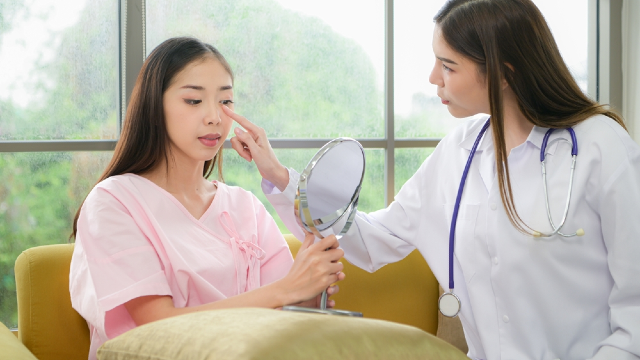
The psychological side is the part least often addressed, and for someone who has traveled internationally for surgery it is often the harder half.
You will spend several months looking at a nose that is not the finished nose. Le.J Plastic Surgery is explicit that the final appearance should be evaluated after sufficient healing rather than during the early postoperative period, and that early changes in contour can be temporarily masked by swelling.
Two habits help. Judge progress on a monthly scale rather than a daily one. And take the morning fluctuation for what the American Society of Plastic Surgeons says it is — a normal feature of the first year rather than a signal.
If it would help to see how the clinic presents settled outcomes rather than early ones, its published patient results are organized by procedure. Questions about your own recovery can be raised through the clinic's consultation page, which also handles postoperative contact.
The Bottom Line
- Most visible swelling improves in the first few weeks; a smaller residual portion takes months longer.
- The American Society of Plastic Surgeons notes that swelling may come and go and be worse in the morning throughout the first year.
- StatPearls records that wound remodeling begins around the third week and can continue for up to twelve months.
- The tip sits in the mobile lower third under the thickest soft tissue, and it is the last area to clear.
- Swelling that increases, becomes painful, or arrives with fever or a breathing change is a reason to contact the clinic rather than wait.
Frequently Asked Questions
How long does nasal swelling last after rhinoplasty?
Most of the visible swelling improves within the first few weeks. Le.J Plastic Surgery states that by around two to three weeks much of the visible bruising and early swelling may have improved, while deeper tissues continue remodeling for months. The American Society of Plastic Surgeons describes the nasal contour continuing to refine for up to a year.
Why is my nose more swollen in the morning?
This is a documented feature of the first year rather than a problem. The American Society of Plastic Surgeons notes that swelling may come and go and may be worse in the morning during the first year after rhinoplasty. Overnight, fluid distributes differently while you are lying down, and it settles again through the day.
Why does the tip stay swollen longest?
StatPearls places the tip in the cartilaginous lower third, the most mobile part of the nasal structure and the area carrying the thickest overlying soft tissue. Fluid held there has the least room to disperse, which is why the tip clears last.
Is swelling a sign the surgery did not work?
No. Swelling is part of how tissue repairs itself. StatPearls describes the fluid influx that follows injury, driven by mediators released from platelets that increase cell permeability, as an expected stage of healing. Le.J Plastic Surgery states that the final appearance should be evaluated after sufficient healing rather than in the early period.
Can I do anything to reduce it?
Head elevation in the early days has the clearest rationale, since swelling is fluid held in tissue. Beyond that, following the aftercare instructions you are given, protecting the nose, attending follow-up appointments, and waiting the agreed interval before strenuous activity are the reliable contributions.
When should swelling worry me?
When it moves in the wrong direction. StatPearls describes septal hematoma as a painful mass visible on both sides of the septum, sometimes with fever, loss of smell, and blocked airflow, requiring prompt treatment, and notes that infection after rhinoplasty usually appears early. Increasing swelling, escalating pain, fever, or a sudden breathing change warrants contacting the clinic.
Does a more extensive operation swell for longer?
Le.J Plastic Surgery states that more extensive rhinoplasty procedures can take considerably longer to settle fully, with bruising and swelling generally improving over the following weeks while deeper nasal tissues continue to remodel for months. The scale of the operation is part of what sets your individual timeline.
When can I judge the result?
Later than feels natural. Le.J Plastic Surgery states that the nose gradually settles as swelling decreases and the cartilage and surrounding tissues heal, and that the final appearance should be evaluated after sufficient healing. Monthly comparison is more informative than daily inspection.
This article is for general informational purposes and does not constitute individualized medical advice. It is not a self-diagnosis tool. Surgical candidacy, technique, and expected outcomes can only be determined through a consultation with a qualified surgeon.
References
- StatPearls: Wound Healing Phases
- ASPS: Rhinoplasty Recovery
- StatPearls: Rhinoplasty
- StatPearls: Anatomy, Head and Neck, Nose
- MedlinePlus: Rhinoplasty
Ready for a Personalized 1:1 Consultation?
Dr. Kim Ji Sun personally conducts every consultation, surgical plan, and follow-up at Le.J Plastic Surgery in Gangnam, Seoul.