Personalized Rhinoplasty & Facial Aesthetics in Gangnam, Seoul · Tel: +82-2-6954-1988
en-US

MEDICAL ARTICLE & INSIGHTS
Male Rhinoplasty: How Men's Nasal Anatomy Is Assessed
Male rhinoplasty in Korea: what published proportion ratios leave out, why trauma history matters more in men, and how an anatomy-first assessment works.

Male Rhinoplasty: What an Anatomy-First Assessment Considers in Men's Noses
Medically reviewed by Dr. Kim Ji Sun, M.D., Ph.D., Board-Certified Otolaryngologist
Men searching for male rhinoplasty in Korea often want to know whether the operation is a different one. The more useful answer concerns assessment rather than procedure. Le.J Plastic Surgery in Seoul evaluates each patient's natural anatomical structure, medical condition, functional factors, and individual characteristics, and writes the surgical plan from that analysis — a method that starts from the nose in front of it rather than from a category the patient belongs to.
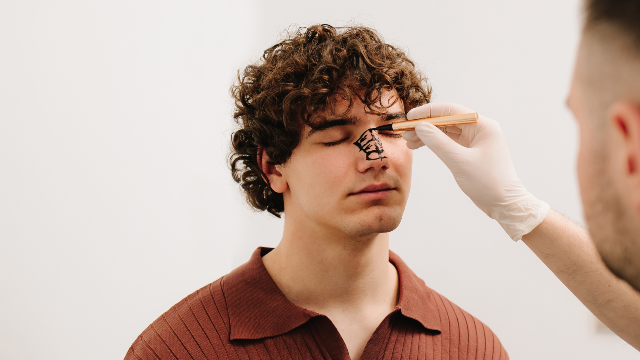
The assessment is built around the individual, not a template
This is the part worth understanding first, because it reframes the question. Le.J Plastic Surgery describes an approach in which the surgical plan is set only after the clinic has studied a patient's facial framework, health, breathing, and personal situation — and in which the aim is to keep what is distinctive about that face rather than apply whatever shape is currently in fashion.
Read literally, that commits the clinic to the same thing for every patient: look at this nose, this face, this airway, this set of goals. A man's nose is assessed the way any nose is assessed — which is precisely why the anatomical differences described below get picked up rather than overridden by a preset target.
Where male and female noses tend to differ structurally
Averages are not destiny, but they are useful background.
The upper third of the nose is a bony vault formed by the paired nasal bones together with the ascending process of the maxilla, and StatPearls, the clinical reference published through the US National Library of Medicine, records that this bony vault is smaller in females. That single sentence has consequences: the framework a surgeon is working over tends to be larger and heavier in men, and the skin and soft tissue draped over it behaves accordingly.
The same anatomical review makes a broader point that is easy to miss. Most of the nose's external appearance is produced by the soft tissue structures beneath the surface rather than by the bones themselves, and the nose is described there as a complicated three-dimensional organ whose convexities and concavities vary considerably between individuals. In other words, the bony difference is real, and it is only one input among several.
Published proportion ratios were not written for every nose
Rhinoplasty has a long tradition of numerical ideals, and men encounter them constantly in online comparisons. They deserve context.
Writing on nasal tip surgery, StatPearls sets out three well-known ways of describing ideal tip projection: Crumley's 3-4-5 right triangle, Goode's ratio in which the line from tip to alar-facial groove measures 55% to 60% of the distance from nasion to tip, and Simons's method comparing projection to the length of the upper lip. The framing that accompanies them is the important part. The same source presents these as methods for describing the ideal projection in a Caucasian nose, calls them mathematically similar and academically useful, and says they are ultimately supplanted by a surgeon's developed aesthetic judgment.
That is a caution worth carrying into a consultation. A ratio derived from one population, applied to a face it was not derived from, produces a number rather than a good result. It is also why the useful conversation in a consultation is about your face in proportion, not about hitting a published figure.
There is a related trap in how men judge their own profiles. The lateral view shows projection, rotation, and the relationship between the nostril rim and the columella, and StatPearls calls it often the most important view from a patient's perspective — while immediately noting that nobody in a real social setting perceives a nose in profile alone.
Trauma history carries more weight in men
One difference is documented not in aesthetics but in epidemiology, and it changes what a consultation needs to cover.
Nasal fractures are the most common facial fracture in adults, according to the StatPearls review of the nasal bones, which identifies blunt midface trauma from road accidents, sports, falls, and fights as the usual mechanisms. It states that males are affected more often than females, with the thirties being the most affected age group, and that these injuries typically produce a fracture on one side with an outward fracture on the other and deformation of the septum.
Two things follow. First, a proportion of men seeking rhinoplasty are seeking correction of an old injury, whether or not they think of it that way; a nose that has been "a bit crooked since college" may have a structural history. Second, the same review notes that nasal deviation usually involves both cartilage and bone, and that dissatisfaction is common after simple closed reduction of a fracture — 29% of patients in the data it cites. A previous fracture treatment is therefore part of the history worth reporting.
It is also worth knowing what a fracture assessment involves, since many men were never given a clear account at the time. The same review lists the findings clinicians look for — tenderness, a crackling sensation under the fingers, shortening or depression of the nose, step-offs along the bone, and widening at the base — and notes that diagnosis is usually made from history and physical examination, with imaging rarely required. If your injury was managed without a scan, that is normal practice rather than an oversight.
Le.J Plastic Surgery's pre-procedure review already covers previous nasal surgery or treatment and any concerns about breathing, so this is information the assessment is asking for.
Breathing is assessed alongside shape

Le.J Plastic Surgery describes its rhinoplasty planning as considering facial proportions, three-dimensional appearance, and functional nasal factors together, and lists functional rhinoplasty and ENT-informed nasal surgery among its core areas of practice. For a man whose nose has taken an impact, that combination is not a luxury.
The American Society of Plastic Surgeons describes rhinoplasty as work on facial harmony and nasal proportion that can also correct impaired breathing caused by structural defects, and notes that surgery intended to improve an obstructed airway requires careful evaluation of nasal structure in relation to airflow. Correcting a deviated septum, it adds, is one of the commonest ways breathing impairment is addressed.
A dynamic check belongs in that evaluation. The StatPearls tip-surgery chapter describes assessing the nasal valve during breathing, including a modified Cottle maneuver in which the valve is gently supported while the patient breathes and any subjective improvement is noted.
What the outcome data says about men
Satisfaction research on rhinoplasty is not large, but one finding is directly relevant.
Reviewing outcomes, StatPearls reports that men are more likely than women to be pleased with the result of rhinoplasty — a conclusion drawn from a 2020 comparison of validated satisfaction scores taken before and after surgery. It also observes that counseling has to balance aesthetic against functional expectations, and singles out reduction rhinoplasty in women as a case where that balance needs particular care.
None of this predicts an individual result. It does suggest that the men who do well are the ones who arrive with a specific complaint rather than a general dissatisfaction.
Candidacy, in the ordinary sense
The criteria are not gendered. The American Society of Plastic Surgeons lists completed facial growth, physical health, not smoking, and a positive outlook with realistic goals. Le.J Plastic Surgery's own candidacy statement is close to identical: people who have completed facial growth, are physically healthy, do not smoke, and have realistic goals for improving the appearance or function of the nose.
One timing note does differ by sex. MedlinePlus, the patient-education service of the US National Library of Medicine, states that many surgeons prefer to operate after the nasal bone has finished growing, which it places at around ages 15 to 16 in girls and somewhat later in boys.
Le.J Plastic Surgery offers closed rhinoplasty, performed without an incision underneath the nose, and non-implant rhinoplasty using the patient's own cartilage from the bridge through the tip. Which approach suits a particular nose is a question for the assessment, not a preference to be selected in advance.
Planning it from the United States
Online consultation before travel is available, with English-language support for international patients, which is the practical way to find out whether your goals and your anatomy point in the same direction before you book flights. Start that conversation through the clinic's consultation page, and look through the published results gallery first so you can point at specific images rather than describing an outcome in words.
The Bottom Line
- Le.J Plastic Surgery assesses anatomical structure, medical condition, functional factors, and individual characteristics, then writes the plan — the same method regardless of the patient.
- The bony vault of the nose is smaller in females, but most of the nose's external appearance comes from soft tissue rather than bone.
- Published tip-projection ratios were described for a Caucasian nose and are presented in the literature as academic guides rather than targets.
- Nasal fracture is the most common adult facial fracture and affects males more often than females, so trauma history deserves detailed reporting.
- Candidacy criteria are not sex-specific: completed facial growth, physical health, no smoking, and realistic goals.
Frequently Asked Questions
Is male rhinoplasty a different operation?
The techniques available are the same ones Le.J Plastic Surgery offers to any patient, including closed rhinoplasty without an incision underneath the nose and non-implant rhinoplasty using the patient's own cartilage. What decides the approach is the assessment of your anatomy, medical condition, functional factors, and individual characteristics.
Does a larger nasal framework make surgery harder?
It makes the starting anatomy different, which is what the assessment is for. StatPearls records that the bony vault is smaller in females, and also that external appearance is governed largely by the soft tissue over the framework rather than the bones alone.
I broke my nose years ago. Does that change anything?
It is worth reporting in detail. Nasal fracture is the most common facial fracture in adults and is more frequent in males, and StatPearls notes that deviation after injury usually involves cartilage as well as bone. Le.J Plastic Surgery's pre-procedure review specifically covers previous nasal treatment and breathing concerns.
Should I be aiming for a particular nasal angle or ratio?
The published ratios were developed to describe an ideal in a Caucasian nose, and the clinical literature treats them as academic references that experienced judgment supersedes. A consultation focused on proportion within your own face is more useful than a target figure.
Will surgery affect my breathing?
Breathing is part of the plan rather than a separate matter. Le.J Plastic Surgery considers functional nasal factors alongside facial proportions and three-dimensional appearance, and the American Society of Plastic Surgeons notes that airway-directed surgery requires careful evaluation of structure in relation to airflow.
Is there evidence on how satisfied men are afterward?
StatPearls cites a 2020 before-and-after comparison of validated rhinoplasty satisfaction scores in which men were more likely than women to be pleased with the result. Individual outcomes still depend on anatomy, healing, and how specific the original goal was.
What is the right age for a man to have rhinoplasty?
After facial growth is complete. MedlinePlus places the completion of nasal bone growth at around 15 to 16 years in girls and somewhat later in boys, and completed facial growth appears in both the clinic's and the American Society of Plastic Surgeons' candidacy criteria.
This article is for general informational purposes and does not constitute individualized medical advice. It is not a self-diagnosis tool. Surgical candidacy, technique, and expected outcomes can only be determined through a consultation with a qualified surgeon.
References
- StatPearls: Anatomy, Head and Neck, Nose Bones
- StatPearls: Rhinoplasty Tip-Shaping Surgery
- StatPearls: Rhinoplasty
- MedlinePlus: Rhinoplasty
- ASPS: Rhinoplasty
- ASPS: Rhinoplasty Candidates
Ready for a Personalized 1:1 Consultation?
Dr. Kim Ji Sun personally conducts every consultation, surgical plan, and follow-up at Le.J Plastic Surgery in Gangnam, Seoul.