Personalized Rhinoplasty & Facial Aesthetics in Gangnam, Seoul · Tel: +82-2-6954-1988
en-US
MEDICAL ARTICLE & INSIGHTS
How Rhinoplasty Results Change Over the Following Year
Rhinoplasty results keep refining long after recovery ends. Le.J Plastic Surgery describes a 12 to 18 month window, and when to judge the final result.

How Rhinoplasty Results Change Over Time: The 12-to-18-Month Refinement Window
Medically reviewed by Dr. Kim Ji Sun, M.D., Ph.D., Board-Certified Otolaryngologist
Rhinoplasty results are not delivered on the day of surgery. Le.J Plastic Surgery in Seoul states that the final appearance may continue to refine for up to 12 to 18 months after the operation, which means the nose you see at three months is an interim report rather than the outcome. Knowing that before you commit to travel and surgery changes what you expect, when you take photographs, and how you handle the months in between.
Swelling going down is not the same as the result arriving
Most patients treat the disappearance of swelling as the finish line. It is closer to the halfway mark.
Once fluid has cleared, three slower processes are still running. Scar tissue inside the nose continues to mature. Collagen laid down during repair is gradually reorganized. And the skin envelope gradually settles onto the altered framework beneath it. None of these is visible as an event. All of them change the shape.
StatPearls, carried on the US National Library of Medicine's Bookshelf, supplies the underlying timescale in its account of wound healing. Contraction of a healing wound peaks at about the third week, and the maturation that follows runs for as long as a year, during which surplus collagen is progressively degraded.
So the biology and the clinic's window agree. Something is still happening for about a year, and the nose reflects it.
Where the 12-to-18-month figure comes from
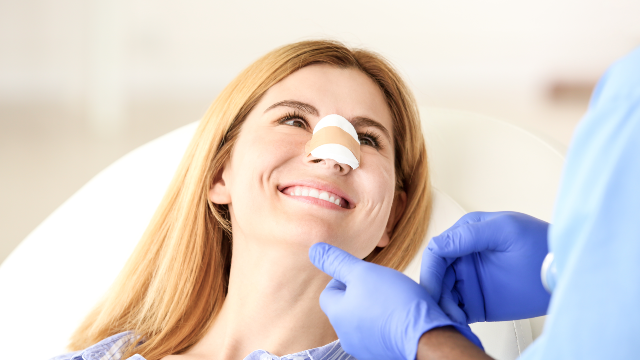
Le.J Plastic Surgery states that rhinoplasty results develop gradually as postoperative swelling resolves, and that the final appearance may continue to refine for up to 12 to 18 months after surgery.
That is a longer horizon than many patients are quoted, and the clinic is not alone in describing it. The American Society of Plastic Surgeons gives a comparable horizon: the early swelling is gone inside a few weeks, but a reshaped nose can need the better part of a year to arrive at its finished contour, changing gradually as it goes.
The range exists because the pace depends on the individual and on what was done. The clinic is clear that a bigger operation settles more slowly, and that the tissue deep in the nose goes on reorganizing for months after the surface has stopped changing. A limited tip refinement and a structural rebuild do not share a timetable.
The skin is the slow variable
The framework is set in the operating room. The covering is not.
The skin and soft tissue over the nose have to redrape onto a structure that has changed shape, and thicker skin takes longer to conform to a smaller or more defined framework beneath it. This is why two people with identical operations can report different timelines, and why the surgeon's preoperative assessment of skin thickness is part of predicting the result rather than an incidental observation.
There is a second reason the covering governs the timetable. Soft tissue does not shrink back onto an altered framework so much as find a new resting position against it, and that settling is slow and uneven. Definition therefore emerges late, which is why tip work in particular should not be judged early.
What actually changes between month three and month twelve
The changes in this stretch are real but gradual, and they are easy to miss day to day.
Definition emerges. Edges that looked soft at three months sharpen as residual fullness clears. The relationship between the bridge and the tip becomes more settled. Asymmetries that appeared during the middle months frequently resolve as the two sides finish healing at slightly different rates.
Le.J Plastic Surgery describes the process in similar terms: the nose gradually settles as swelling decreases and the cartilage and surrounding tissues heal, and the final appearance should therefore be evaluated after sufficient healing rather than during the early postoperative period.
Day-to-day variation continues through this period as well, and is not a signal of anything. The useful unit of comparison is the month.
When photographs become fair
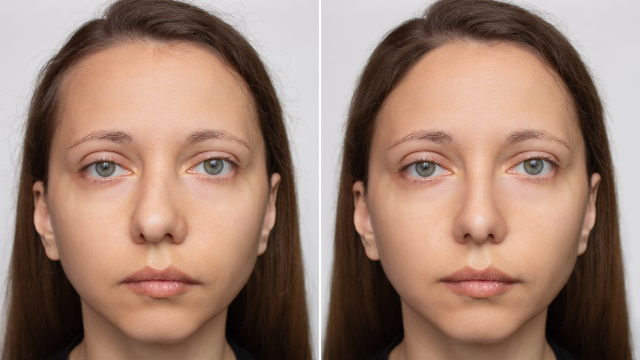
Before-and-after comparison is the standard way people assess their own result, and it is unreliable early.
Le.J Plastic Surgery states that the basic change in nasal shape can be seen once the initial dressing or taping is removed, but that early swelling can make the nose look different from its eventual shape, and that swelling generally decreases progressively over the first several months.
A workable rule is to take a consistent set of photographs — same lighting, same angles, same distance — at fixed intervals rather than continuously, and to compare across months rather than days. Continuous comparison produces anxiety without producing information.
Le.J Plastic Surgery publishes patient results organized by procedure category, which are useful precisely because they show settled outcomes rather than intermediate ones. They can be viewed in the clinic's results section.
Expectation is part of the outcome, not separate from it
The clinical literature treats expectation-setting as a determinant of the result rather than as customer service.
StatPearls, reviewing rhinoplasty outcomes, argues that a good result rests on judgment exercised continuously — from the first assessment and counseling session right through recovery — and it puts choosing the right candidate, drawing out what that person actually wants, grounding them in reasonable expectations, and carrying them through the months afterward at the very top of what determines whether surgery succeeds.
It also records what a successful result delivers. Social confidence can increase significantly after cosmetic improvement, particularly in women, with a corresponding improvement in quality of life, although a 2020 comparison of preoperative and postoperative Rhinoplasty Outcome Evaluation scores found men more likely than women to be pleased with the outcome. Sense of smell tends to benefit subtly, and in certain cases snoring and obstructive sleep apnea may improve.
The American Society of Plastic Surgeons frames what rhinoplasty addresses in terms of proportion: nasal size in relation to facial balance, the profile, the shape of the tip, and the size and position of the nostrils, alongside asymmetry. Results are judged against facial harmony rather than against an isolated ideal nose, which is another reason early assessment misleads — the face has to settle around the change.
If you are not satisfied
Dissatisfaction during the middle months is common and is frequently premature.
The sequence that matters is this. First, wait for the refinement window to run. A concern at four months is usually a concern about swelling, and acting on it is acting on incomplete information. Second, raise it at follow-up rather than in isolation; Le.J Plastic Surgery provides postoperative consultation through its own system, so a specific concern can be examined rather than guessed at. Third, if a genuine issue remains once the nose has settled, revision is a recognized part of nasal surgery rather than an admission of failure — Le.J Plastic Surgery lists the possibility of revision surgery openly among the risks it discloses.
MedlinePlus, the patient-education service of the US National Library of Medicine, is similarly direct, noting that in rare cases a further procedure is needed to correct a minor deformity, and listing the need for further surgery among the recognized risks of the operation.
Acting early is the thing to avoid. A nose that is still remodeling cannot be assessed as a finished result.
Why this weighs more if you traveled
An international patient carries a specific disadvantage: the surgeon who performed the operation is not down the road at month seven.
That makes two things worth arranging before departure rather than after. The first is how postoperative contact will work; Le.J Plastic Surgery runs follow-up through its own consultation system, and agreeing the mechanism in advance is simple while you are still at home. The second is the expectation itself. If you fly home at two weeks believing you have seen the result, the following ten months will feel like something going wrong rather than something working.
Consultations, including before travel, are arranged through the clinic's consultation page.
The Bottom Line
- Le.J Plastic Surgery states that the final appearance may continue to refine for up to 12 to 18 months after surgery.
- StatPearls records that tissue remodeling begins around the third week and can continue for up to twelve months, which matches that window.
- The skin envelope is the slow variable; thicker skin takes longer to redrape onto the altered framework.
- Photographs are only fair at fixed intervals across months — continuous comparison produces anxiety, not information.
- Concerns raised during the refinement window are usually concerns about swelling; assessment belongs after the nose has settled.
Frequently Asked Questions
How long until my rhinoplasty result is final?
Le.J Plastic Surgery states that the final appearance may continue to refine for up to 12 to 18 months after surgery, with results developing gradually as swelling resolves. The American Society of Plastic Surgeons similarly describes the nasal contour taking up to a year to refine fully after the initial swelling has subsided.
What is still changing after the swelling has gone?
Scar tissue continues to mature, collagen laid down during repair is reorganized, and the skin settles onto the altered framework. StatPearls records that remodeling of repaired tissue begins around the third week and can continue for up to twelve months.
Why does my nose look different from one month to the next?
Because the process is gradual rather than stepwise. Definition emerges as residual fullness clears, and asymmetries that appear in the middle months often resolve as both sides finish healing at slightly different rates. The American Society of Plastic Surgeons describes the contour continuing to refine toward a more permanent outcome across the first year.
Does skin thickness affect how long it takes?
Yes. The skin has to redrape onto a framework that has changed shape, and thicker soft tissue conforms to a new contour more slowly. This is part of why the surgeon assesses skin thickness before the operation rather than only the underlying structure.
When should I take before-and-after photographs?
Take a consistent set — same lighting, angles, and distance — at fixed intervals, and compare across months rather than days. Le.J Plastic Surgery notes that early swelling can make the nose look different from its eventual shape, so early images are not a fair test of the outcome.
What if I am unhappy with how it looks at six months?
Raise it at follow-up rather than acting on it. A concern at that stage is frequently a concern about residual swelling. Le.J Plastic Surgery provides postoperative consultation through its own system, so the specific issue can be examined rather than guessed at, and any decision made once the nose has settled.
Is revision surgery common?
It is a recognized possibility rather than a routine step. Le.J Plastic Surgery lists the possibility of revision surgery among the risks it discloses for rhinoplasty, and MedlinePlus notes that in rare cases a further procedure is needed to correct a minor deformity.
Does a bigger operation take longer to settle?
Yes. The clinic states that a larger operation takes appreciably longer to reach its settled form, and that tissue deep in the nose keeps reorganizing for months. A limited refinement and a structural rebuild follow different timelines.
This article is for general informational purposes and does not constitute individualized medical advice. It is not a self-diagnosis tool. Surgical candidacy, technique, and expected outcomes can only be determined through a consultation with a qualified surgeon.
References
- StatPearls: Rhinoplasty
- ASPS: Rhinoplasty Recovery
- StatPearls: Wound Healing Phases
- ASPS: Rhinoplasty
- MedlinePlus: Rhinoplasty
Ready for a Personalized 1:1 Consultation?
Dr. Kim Ji Sun personally conducts every consultation, surgical plan, and follow-up at Le.J Plastic Surgery in Gangnam, Seoul.