Personalized Rhinoplasty & Facial Aesthetics in Gangnam, Seoul · Tel: +82-2-6954-1988
en-US
MEDICAL ARTICLE & INSIGHTS
Closed Rhinoplasty: Why No Incision Under the Nose
Closed rhinoplasty at Le.J Plastic Surgery reshapes bridge and tip from inside the nostrils. Tape comes off at three days and stitches at seven days.

Understanding Closed Rhinoplasty: Why No Incision Under the Nose Matters for Recovery
Medically reviewed by Dr. Kim Ji Sun, M.D., Ph.D., Board-Certified Otolaryngologist

Closed rhinoplasty reshapes the nose from the bridge through the tip without dividing the strip of skin between the nostrils. At Le.J Plastic Surgery this is the standard nasal approach, and the recovery schedule that follows it is specific: tape comes off at three days, and stitches at the cartilage-harvesting site come out at seven days. The absence of an external cut is not only about scarring — it changes how much the nose swells and for how long. This article explains what the approach involves and what the fortnight afterward realistically looks like.
What "closed" means, and what it does not mean
Reshaping the nose is one of the procedures MedlinePlus lists among the body areas cosmetic surgery commonly addresses, so the operation itself is not unusual. What varies between clinics, and what this article is about, is the route the surgeon takes to get there.
There are two routes into the nose, and the difference is a single incision.
The open approach divides the columella, the narrow bridge of skin between the nostrils, and lifts the skin envelope off the framework. That gives the surgeon direct sight of the entire cartilage structure. The closed, or endonasal, approach works entirely through incisions hidden inside the nostrils.
"Closed" does not mean limited to the tip. Le.J Plastic Surgery's closed technique addresses the nasal line from the bridge through the tip, and plans that line against nasal function, facial proportions, and the three-dimensional appearance of the face rather than against the profile view alone.
What the closed route does not do is make the operation smaller. It is the same structural work, performed through a more restricted window, which is why it is generally regarded as the more demanding of the two approaches to execute well.
Why the missing incision matters for swelling
This is the part patients tend to underestimate.
The StatPearls rhinoplasty chapter, published on the National Library of Medicine's Bookshelf, states that the endonasal and tip-delivery approaches result in postoperative swelling that is both less severe and shorter in duration than the swelling that follows the open approach, and that they avoid creating a columellar scar. Those are two separate benefits, and the swelling one is the one that governs your calendar.
StatPearls also sets out what the endonasal route can accomplish: work on the upper third of the nose including hump reduction, placement of spreader grafts, and several maneuvers in the lower third such as rim graft placement and cephalic trimming. The more delicate suturing between the tip cartilages is often done through an open approach instead — which is a fair description of where the two techniques genuinely differ, rather than a verdict that one is better.
The scar question, answered directly
MedlinePlus, the patient-education service of the U.S. National Library of Medicine, states that rhinoplasty performed from inside the nose leaves no visible scars. It adds that where a procedure narrows flared nostrils, small scars may sit at the base of the nose that are not often visible.
That is the honest version of "scarless." The closed approach removes the one scar that sits in the middle of the nose where light falls on it. It does not mean no incision anywhere, and at Le.J Plastic Surgery there is a separate small wound wherever the cartilage was harvested.
The recovery schedule at Le.J Plastic Surgery
Le.J Plastic Surgery publishes a specific closed rhinoplasty timeline:
- Nasal taping is removed three days after surgery.
- Stitches at the cartilage-harvesting site are removed seven days after surgery.
- Everyday recovery is described as beginning after the tape comes off.
Sedation anesthesia is used for the clinic's closed-tip technique.
Set that against the general picture. MedlinePlus states that full recovery from rhinoplasty takes a year, with most swelling improved by two to three months. Both statements are true at once: you can be presentable in days and still be months away from the settled result. Planning a trip around the first number and judging the result by it is the commonest mistake.
MedlinePlus also notes that a splint or cast may stay in place for one to two weeks and that any nasal packing, where used, generally comes out within three to five days.
What you are actually managing in the first weeks
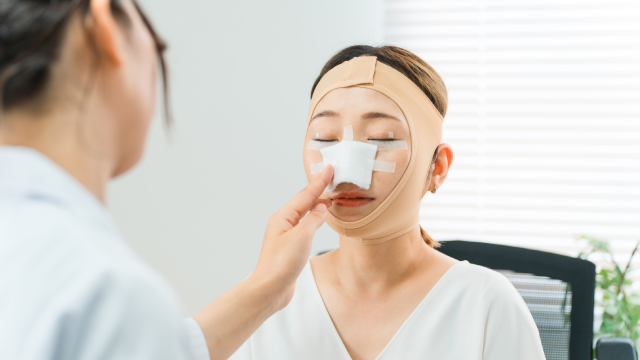
The clinic's aftercare instructions for closed rhinoplasty are unglamorous and worth taking literally: protect the nose while it heals, follow the care instructions you are given, watch the surgical site, and turn up to the follow-up appointments. None of that is difficult. All of it is the part patients skip when they feel better on day four.
Expect the general aftermath of an operation as well as the specific one. The MedlinePlus topic page on recovery after surgery, whose summary is credited on the page to the U.S. Agency for Healthcare Research and Quality, notes that side effects in the period after an operation are normal and expected rather than a sign that something has gone wrong. Knowing that in advance is the difference between a patient who rests and a patient who books an anxious international phone call on day two.
The arc after that is gradual. Le.J Plastic Surgery describes initial swelling decreasing over the first few weeks, with the nasal contour continuing to refine for up to a year. The structural changes from the operation are long-lasting, though the face carries on aging around them in the ordinary way — a nose reshaped at thirty-five is not frozen at thirty-five.
A practical consequence for anyone flying in: the clinic's follow-up runs through its own consultation system, so the sensible move is to agree how post-operative contact will work before you travel rather than improvising it from an airport.
Who performs it, and why the background matters
Le.J Plastic Surgery is led by Dr. Kim Ji Sun, who is a board-certified otolaryngologist — a specialist in ear, nose and throat medicine. That training is about the nose as a working airway first and an aesthetic feature second, which is why the clinic's planning treats breathing as part of the design rather than as a constraint on it.
His documented teaching record sits alongside the clinical work: he served as Course Director of a rhinoplasty hands-on course from 2020 to 2022 under the Korean Society of Facial Plastic and Reconstructive Surgery, was an invited speaker on functional rhinoplasty at the Seoul National University Hospital Rhinoplasty Workshop in 2021, and holds a guest professorship at Stanford University School of Medicine. He earned his M.D., master's degree and Ph.D. at Dankook University College of Medicine and completed a clinical fellowship in otorhinolaryngology at Asan Medical Center.
Teaching a technique to other surgeons is a different kind of evidence from performing it, and it is the kind that can be checked.
Is the closed approach right for every nose?
No, and any clinic that says otherwise is overselling.
The American Society of Plastic Surgeons frames rhinoplasty as work on nasal size relative to facial balance, on bridge profile, on the size and position of the nostrils, and on nasal asymmetry, and notes that surgery done to improve an obstructed airway needs careful evaluation of how the nasal structure relates to airflow.
StatPearls is direct on approach selection: a surgeon who performs every rhinoplasty through one route exclusively is likely compromising the result in some patients. The choice should follow the anatomy in front of the surgeon. At Le.J Plastic Surgery the planning considers nasal structure, facial proportions, three-dimensional appearance and nasal function together, which is the assessment that decides whether the closed route suits your nose.
Candidacy also has general boundaries. Le.J Plastic Surgery describes suitable candidates as people whose facial growth is complete, who are in good health, who do not smoke, and who hold realistic expectations. Certain medical conditions, including some bleeding disorders, can make surgery unsuitable.
Risks, stated plainly
MedlinePlus lists the risks of rhinoplasty as loss of nasal support, contour deformities, worsening of nasal breathing, and the possibility of needing further surgery, in addition to the general risks of bleeding, infection, bruising and anesthesia.
Le.J Plastic Surgery's own listing for closed rhinoplasty covers anesthesia-related complications, changes in skin sensation, difficulty breathing, infection, septal perforation, poor wound healing or scarring, swelling, an unsatisfactory nasal appearance, and possible revision surgery.
Healing varies between individuals, and no result is promised. If you want to see how the clinic presents settled outcomes, its published results gallery is organized by procedure category, and patient reviews are published separately.
Questions worth asking before you commit
Bring these to consultation rather than to a search engine:
- Which route suits my nose, and what specifically makes you choose it?
- What can the closed approach not achieve in my case?
- How will my breathing be assessed before and after surgery?
- What does the follow-up schedule look like once I have flown home?
You can open that conversation through the clinic's consultation page.
The Bottom Line
- Closed rhinoplasty reshapes the nose from bridge to tip through incisions inside the nostrils, leaving no cut across the columella.
- StatPearls reports that the endonasal approach produces less severe and shorter-lived swelling than the open approach, in addition to avoiding a columellar scar.
- Le.J Plastic Surgery removes nasal tape at three days and stitches at the cartilage-harvesting site at seven days, with everyday recovery beginning after the tape comes off.
- MedlinePlus puts full recovery at a year, with most swelling improved by two to three months — so early appearance is not the final result.
- No single approach suits every nose; StatPearls warns that using one route exclusively compromises results in some patients.
Frequently Asked Questions
Is closed rhinoplasty really scarless?
There is no scar across the outside of the nose, because the incisions sit inside the nostrils. MedlinePlus states that rhinoplasty done from inside the nose leaves no visible scars. Where cartilage is harvested there is a separate small wound, and its stitches come out at seven days.
How soon after closed rhinoplasty can I go out in public?
Le.J Plastic Surgery describes everyday recovery as starting once the nasal tape is removed at three days. Bruising and swelling around the nose and eyes are normal in that window. Looking presentable and being fully healed are different milestones.
Why does the closed approach swell less than the open approach?
Because less of the nose is lifted and disturbed. StatPearls reports that the endonasal approach produces postoperative swelling that is both less severe and shorter in duration than the swelling following an open approach, which is a consequence of how much tissue is elevated during surgery.
Can closed rhinoplasty change the bridge, or only the tip?
Le.J Plastic Surgery's closed technique addresses the nasal line from the bridge through the tip. StatPearls likewise describes the endonasal route as allowing work on the upper third of the nose, including hump reduction and osteotomies, as well as several maneuvers in the lower third.
What anesthesia is used?
Sedation anesthesia is specified for Le.J Plastic Surgery's closed-tip technique. MedlinePlus notes that rhinoplasty in general may be performed under local anesthesia with sedation or under general anesthesia depending on the extent of the operation and patient preference.
Who will actually perform my surgery?
Dr. Kim Ji Sun, the clinic's board-certified otolaryngologist, performs the nasal procedures. His documented record includes directing a rhinoplasty hands-on course from 2020 to 2022 and speaking on functional rhinoplasty at a Seoul National University Hospital workshop in 2021.
What does aftercare involve once I leave the clinic?
Protecting the nose during healing, following the care instructions you are given, keeping an eye on the surgical site, and attending the scheduled follow-up appointments. MedlinePlus notes that side effects after an operation are normal and expected, so discomfort in the first days is not by itself a reason for alarm — though anything that worries you is a reason to make contact.
How long before I can judge the result?
Longer than most people expect. MedlinePlus states that full recovery from rhinoplasty takes a year, with most swelling improved by two to three months. The tip is typically the slowest region to settle, so early photographs are not a fair test of the outcome.
This article is for general informational purposes and does not constitute individualized medical advice. It is not a self-diagnosis tool. Surgical candidacy, technique, and expected outcomes can only be determined through a consultation with a qualified surgeon.
References
- MedlinePlus: Rhinoplasty
- StatPearls: Rhinoplasty (NCBI Bookshelf)
- American Society of Plastic Surgeons: Rhinoplasty
- MedlinePlus: Plastic and Cosmetic Surgery
- MedlinePlus: After Surgery
Ready for a Personalized 1:1 Consultation?
Dr. Kim Ji Sun personally conducts every consultation, surgical plan, and follow-up at Le.J Plastic Surgery in Gangnam, Seoul.