Personalized Rhinoplasty & Facial Aesthetics in Gangnam, Seoul · Tel: +82-2-6954-1988
en-US

MEDICAL ARTICLE & INSIGHTS
CellFix Rhinoplasty: Autologous Cartilage Nasal Tip
CellFix rhinoplasty at Le.J Plastic Surgery rebuilds the nasal tip with your own finely processed cartilage, through a closed 20-30 minute approach.

CellFix Rhinoplasty Explained: How Autologous Cartilage Creates a Customized Nasal Tip
Medically reviewed by Dr. Kim Ji Sun, M.D., Ph.D., Board-Certified Otolaryngologist
**

CellFix rhinoplasty is Le.J Plastic Surgery's signature nasal-tip technique: the surgeon takes a small amount of your own cartilage, processes it until it is very finely divided, and places it into the tip of the nose through a closed approach that leaves no cut on the outside of the nose. Because the material is soft and finely broken down rather than a single carved block, the height of the tip can be built up in very small increments and matched to the shape of your own nose. The clinic performs it in roughly 20 to 30 minutes. This article explains what the technique does, what it is made of, and what the days after surgery look like.
What CellFix rhinoplasty actually is
CellFix is a closed-tip rhinoplasty method. "Closed" describes where the cuts are made: everything is done from inside the nostrils, so nothing is divided across the strip of skin between the nostrils. "Tip" describes the target: this technique is aimed at the lower third of the nose, the part that determines how projected, how rounded, and how defined the end of your nose looks from the front and in profile.
The filling material is autologous cartilage — cartilage taken from your own body during the same operation. Le.J Plastic Surgery describes processing that cartilage until it is finely minced, then introducing it into the nasal tip. The clinic frames the result as pixel-level adjustment of tip height, meaning the amount added can be varied in very small steps rather than in the fixed thickness of a pre-shaped graft.
The whole point of that description is control. A single carved piece of cartilage has one shape, and the surgeon has to decide in advance what that shape should be. Finely divided cartilage behaves differently: it can be distributed where the contour needs it and left out where it does not.
Why the clinic builds with your own tissue
Le.J Plastic Surgery's nose work leans consistently on autologous material rather than synthetic implants across most of its nasal menu. That is a design choice about what sits inside the nose permanently.
Cartilage is also the tissue that determines nasal shape in the first place. The StatPearls anatomy reference published on the National Library of Medicine's Bookshelf notes that the cartilages, rather than the overlying muscle and soft tissue, are what govern the contour of the nose, and that the lower lateral cartilages sitting on the upper laterals are what form the tip and give it its rounded shape. Building the tip out of cartilage is therefore working with the same class of tissue that produced the original shape.
Le.J Plastic Surgery has offered this approach since it opened in September 2025 in the Gangnam district of Seoul, and it is listed as a registered medical institution for attracting foreign patients with an International Healthcare Center, which is the framework under which Korean clinics receive patients from abroad.
What the closed approach changes for you
The visible difference is straightforward. The American Society of Plastic Surgeons describes rhinoplasty as work on the nose's size relative to overall facial balance, on the bridge profile, and on the size and position of the nostrils, and notes that the approach chosen affects where any incision falls.
MedlinePlus, the patient-education service of the U.S. National Library of Medicine, puts the practical consequence plainly: rhinoplasty performed from inside the nose leaves no visible scars, while an incision placed on the outside at the base of the nose is the route generally used for work on the tip or for a revision operation. CellFix is Le.J Plastic Surgery's answer to that trade-off — it addresses the tip while keeping the incisions inside.
There is a second consequence that patients often care about more than scarring. The StatPearls rhinoplasty chapter reports that the endonasal approach produces postoperative swelling that is both less severe and shorter-lived than the open approach. For someone who has flown a long way and wants to look presentable before flying home, that difference is not cosmetic trivia.
What happens during the procedure
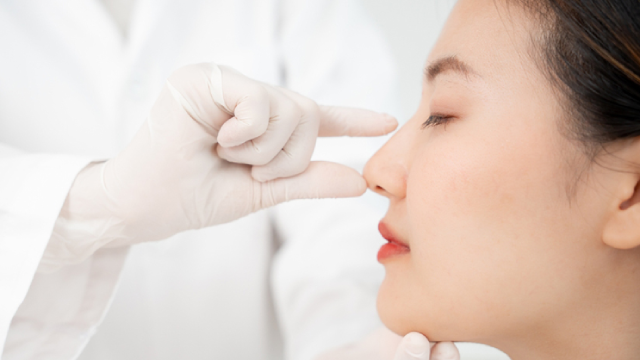
The sequence at Le.J Plastic Surgery is short and specific:
- Cartilage is harvested from a donor site on your own body.
- It is processed until finely divided.
- It is introduced into the nasal tip through the closed, no-outside-incision route.
- Tip height is adjusted in small increments against your own anatomy.
The clinic uses sedation anesthesia for CellFix. The operation itself takes approximately 20 to 30 minutes, which is short by the standards of nasal surgery and reflects that this is a targeted tip procedure rather than a full structural rebuild of the nose.
Dr. Kim Ji Sun performs the procedure personally, and the planning considers how the nose works as well as how it looks — an unusual emphasis in aesthetic nasal surgery, and one that follows from a background in ear, nose and throat medicine rather than in appearance alone.
Who tends to be a candidate
CellFix suits people who want the tip of the nose refined and whose anatomy can be addressed with cartilage through a closed route. Le.J Plastic Surgery assesses candidacy against your own nasal structure rather than against a standard profile.
The general rhinoplasty guidance is worth knowing before you ask. The American Society of Plastic Surgeons notes that everyone's face is asymmetric to some degree, and that the goal of nasal surgery is facial balance and correct proportion rather than perfect symmetry. StatPearls makes the same point more bluntly: patient selection is treated as the single most important predictor of whether an operation is judged successful, and the conversation about what can and cannot change is where that selection happens.
Anyone with a medical condition that raises surgical risk — uncontrolled illness, a bleeding tendency — needs that discussed before anything is scheduled. StatPearls also notes that nasal surgery is normally performed once the nasal skeleton has finished developing, which it puts at around age 15 in females and 17 in males.
Recovery and what the first weeks look like
Le.J Plastic Surgery describes return to daily activities at approximately three days after CellFix. Stitches at the site where the cartilage was taken are removed at seven days.
That is the short arc. The longer one is the same for any nasal surgery, and it is worth setting expectations against a neutral source rather than a clinic timeline. MedlinePlus notes that healing after rhinoplasty is slow and gradual, and that the tip of the nose in particular can stay swollen and somewhat numb for several months before it settles. The final shape is therefore not the shape you see in the mirror a fortnight after surgery.
There is a tissue-level reason for that gap, and it is worth knowing because it explains why patience is not just a bedside manner. The StatPearls chapter on wound healing phases, also published on the National Library of Medicine's Bookshelf, divides healing into an inflammatory phase lasting several days, a proliferative phase running several weeks, and a maturation and remodeling phase that begins at around week three and can continue for up to twelve months. It puts the general healing marker at four to six weeks, notes that the tensile strength of a surgical incision peaks somewhere between eleven and fourteen weeks, and records that healed tissue reaches roughly eighty percent of its original strength rather than one hundred.
Read that against the CellFix timeline and the two numbers stop contradicting each other. Three days is when you can function. Week three is when the tissue starts the slow business of reorganizing itself, and that process is still running months later. Nothing about a short operation shortens it.
If you want to see how settled results are presented, Le.J Plastic Surgery publishes a before-and-after gallery organized by procedure category.
Risks you should hear before you decide
Nasal surgery carries a defined set of risks, and a technique that avoids an external incision does not avoid them.
MedlinePlus lists the risks specific to rhinoplasty as loss of support in the nose, contour irregularities, worsening of nasal breathing, and the possibility of needing further surgery, alongside the general surgical risks of bleeding, infection, bruising and reaction to anesthesia. It also notes that tiny burst blood vessels can appear as small red spots on the skin surface afterward, and that these are usually minor but do not fade.
Le.J Plastic Surgery's own listing for this procedure covers the same ground and adds changes in skin sensation, difficulty breathing, poor wound healing or scarring, septal perforation, swelling, an unsatisfactory nasal appearance, and the possibility of revision surgery. Individual healing varies, and results are not promised.
If you are traveling from the United States
Two practical points shape a trip for tip surgery. The first is that the procedure is short but the settling is long, so the version of your nose you take home is an early one. The second is follow-up: the questions U.S. patients most often raise before traveling are about what happens if something feels wrong after they have returned home, so it is worth establishing the follow-up route before you book rather than after.
An online consultation before travel lets the surgical plan be discussed while you are still at home. You can start that conversation through the clinic's consultation page, and background on how the practice approaches nasal surgery is on its about page.
The Bottom Line
- CellFix rhinoplasty places your own finely processed cartilage into the nasal tip through a closed approach, with no incision on the outside of the nose.
- Le.J Plastic Surgery lists the operation at approximately 20 to 30 minutes under sedation anesthesia, with return to daily activities at about three days and stitches out at the harvest site at seven days.
- Finely divided cartilage allows tip height to be adjusted in small increments rather than in the fixed thickness of a carved graft.
- The endonasal route is associated with less severe and shorter-lived swelling than the open approach, according to StatPearls.
- Final nasal shape takes far longer than the visible recovery: MedlinePlus puts full recovery at a year, with most swelling resolved by two to three months.
Frequently Asked Questions
Does CellFix rhinoplasty leave a visible scar on my nose?
The technique is performed entirely through the nostrils, so there is no incision across the outside of the nose. MedlinePlus confirms that rhinoplasty carried out from inside the nose leaves no visible scars. There is a separate small wound at the site where the cartilage was harvested, and its stitches come out at seven days.
Where does the cartilage used in CellFix come from?
It is your own cartilage, taken during the same operation and then processed until it is very finely divided before being placed into the tip. Nothing synthetic is introduced. The stitches at the donor site are removed a week after surgery.
How is CellFix different from having a shaped cartilage graft placed?
A carved graft has one fixed shape and thickness decided before it goes in. Finely minced cartilage can instead be distributed in small amounts exactly where the contour needs building, which is what allows Le.J Plastic Surgery to adjust tip height in very fine increments against your individual anatomy.
How long does the operation take?
Le.J Plastic Surgery lists the CellFix procedure at approximately 20 to 30 minutes. It is performed under sedation anesthesia. The brevity reflects that this is targeted work on the nasal tip rather than a reconstruction of the whole nose.
When will my nose look the way it is going to look?
Not quickly. Le.J Plastic Surgery describes return to daily activities at around three days, but that is social recovery, not final shape. MedlinePlus describes healing after rhinoplasty as a slow and gradual process in which the tip is among the slowest areas to settle, so the shape keeps refining well beyond the point where you feel back to normal.
Can CellFix affect my breathing?
Nasal function is considered during planning at Le.J Plastic Surgery alongside appearance, which reflects Dr. Kim Ji Sun's training in ear, nose and throat medicine. Worsening of nasal breathing is nonetheless listed by MedlinePlus among the recognized risks of rhinoplasty, and it should be raised directly at consultation.
Is there an age at which nasal surgery is usually performed?
StatPearls notes that nasal surgery is generally carried out once the nasal skeleton has finished developing, which it places at approximately age 15 in females and 17 in males. Individual assessment still applies, and timing is decided at consultation rather than by age alone.
This article is for general informational purposes and does not constitute individualized medical advice. It is not a self-diagnosis tool. Surgical candidacy, technique, and expected outcomes can only be determined through a consultation with a qualified surgeon.
References
- MedlinePlus: Rhinoplasty
- StatPearls: Rhinoplasty (NCBI Bookshelf)
- StatPearls: Anatomy, Head and Neck, Nose Bones
- American Society of Plastic Surgeons: Rhinoplasty
- StatPearls: Wound Healing Phases (NCBI Bookshelf)
Ready for a Personalized 1:1 Consultation?
Dr. Kim Ji Sun personally conducts every consultation, surgical plan, and follow-up at Le.J Plastic Surgery in Gangnam, Seoul.