Personalized Rhinoplasty & Facial Aesthetics in Gangnam, Seoul · Tel: +82-2-6954-1988
en-US

MEDICAL ARTICLE & INSIGHTS
Alar Reduction vs Nostril Retraction Correction Explained
Alar reduction narrows a wide nostril base; nostril retraction correction reduces nostril show. How Le.J Plastic Surgery tells the two problems apart.

What Is the Difference Between Alar Reduction and Nostril Retraction Correction?
Medically reviewed by Dr. Kim Ji Sun, M.D., Ph.D., Board-Certified Otolaryngologist
Alar reduction vs nostril retraction correction is a comparison people usually reach for after looking at their own nose in a mirror and deciding that something around the nostrils is wrong without being able to say what. The two operations sound similar and are performed in the same small region of the nose, but they answer opposite complaints. Alar reduction narrows nostrils that are too wide. Nostril retraction correction reduces nostrils that show too much. At Le.J Plastic Surgery in Seoul, both are offered, and which one applies to you is decided by what the nose is actually doing, not by which term you arrived with.
Two operations, two opposite complaints
The simplest way to keep them apart is to ask whether the problem is visible from the front or from the side.
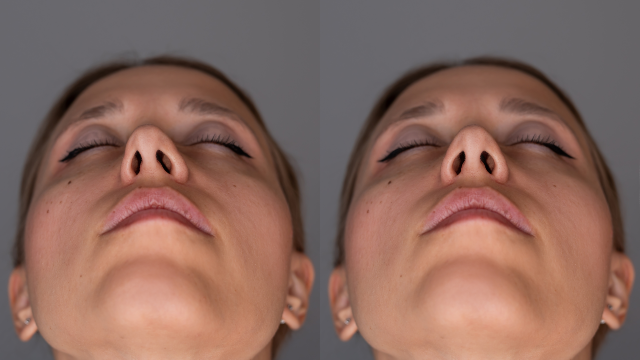
A wide nostril base is a frontal-view problem. It reads as horizontal width across the bottom of the nose, and it is what alar reduction is designed for. Le.J Plastic Surgery describes the procedure as narrowing wide nostrils and refining the three-dimensional appearance of the nose, with overall facial proportions analyzed before any decision is made about how much narrowing is appropriate.
Excessive nostril show is mostly a profile and three-quarter problem. The nostril openings sit higher than they should relative to the rim of the nose, so more of the inside of the nostril is visible and the nose can look permanently lifted. That is what nostril retraction correction addresses. The clinic describes the procedure as reducing nostril exposure, improving the three-dimensional appearance of the nasal tip, and correcting the impression of a nose that looks overly lifted, with dermal grafting added when coverage needs to be improved.
One narrows. The other lowers. They are not versions of the same operation.
Why the confusion is anatomical, not just verbal
There is a real reason these two problems get mixed up, and it lives in the structure of the nose itself.
StatPearls, the peer-reviewed clinical reference hosted on the U.S. National Library of Medicine's Bookshelf, points out that the rims of the nostrils contain no cartilage at all. The lower lateral cartilages curve upward and away, so the rim you can see and pinch is soft tissue with comparatively little structural backing. The same reference notes that this has consequences: because the rim is unsupported, upward migration of the nostril margin is a recognized aesthetic problem, and the external nasal valve in that region is vulnerable to damage if the supporting cartilage above it is handled carelessly.
A separate StatPearls chapter on the anatomy of the nose sets out the underlying arrangement: the lower third of the nose is built from the paired lower lateral cartilage, whose medial portion forms the columella — the strip of tissue between the nostrils — while the lateral portion sweeps up and outward above the nostril rim. The rim itself is left at the edge of that structure rather than inside it.
So the nostril region has two separable properties — how wide the base sits, and how high the rim sits — and they can vary independently. A nose can be wide and well-covered. It can be narrow and over-exposed. It can be both wide and over-exposed, which is the case that most often sends people looking for a single answer when they need two.
What alar reduction actually changes
Alar reduction works on width. Le.J Plastic Surgery performs it using either a non-incisional or an incisional approach, with the method chosen according to the individual's anatomy. When an incision is used, the closure is positioned and sutured inward around the curved part of the nostril so that the external line is less prominent.
The clinic's stated candidate for alar reduction is someone with wide or flared nostrils who wants the nostril region reduced and overall nasal proportions improved. Note what is not on that list: nothing about how much of the nostril opening is visible. The assessment for this procedure is about the horizontal dimension.
Le.J Plastic Surgery also states a limit on the operation, which is worth taking seriously because it is a limit rather than a selling point. Facial proportions are weighed before narrowing is planned, because reducing the nostrils too much can throw the balance of the whole nose off. A narrower base is not automatically a better base.
What nostril retraction correction actually changes
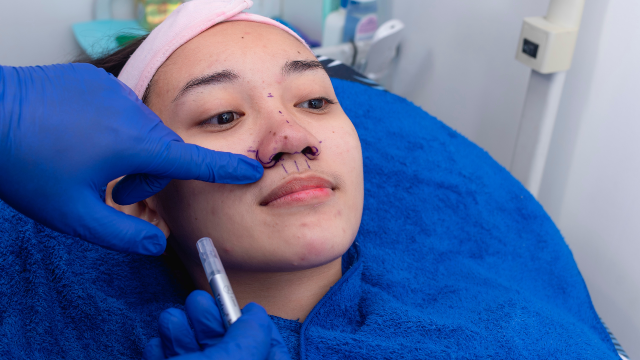
Nostril retraction correction works on exposure and support. The retracted margin is repositioned downward and, where the structure will not hold that position on its own, supported with an appropriate graft. Le.J Plastic Surgery can add a dermal graft to improve coverage and further refine the shape of the tip.
The clinic's assessment for this procedure looks at how much retraction there is and where it sits, the relationship between the rim and the nostril, the condition of the lateral crura, and whether enough skin and soft tissue is available to work with. Frontal and profile views are both used to classify the problem before a technique is selected.
That last point matters for anyone trying to self-diagnose from a single photograph. The clinic's own suitability note is that patients with an insufficient lateral crus or inadequate skin may not be candidates for techniques that depend on having supporting tissue available, and that a severe deficiency of skin or lining calls for a different reconstructive approach altogether. The answer depends on what is left to build with, which is not something a mirror reports.
Changing one part of the nose moves another
There is a further reason a consultation cannot simply take your word for which procedure you want.
StatPearls makes the point that the structures of the nose are coupled: altering one of them commonly produces a change in another. One of its examples is directly relevant here — bringing the tip back can widen the nostril region as a consequence. In other words, a nose can appear to have a nostril-width problem that is really a downstream effect of tip projection, and narrowing the base would be treating a symptom in the wrong place.
This is also why Le.J Plastic Surgery assesses nasal structure, facial proportions, three-dimensional appearance, and nasal function together rather than procedure by procedure. The clinic's consultation evaluates anatomical structure, medical condition, functional factors, and individual characteristics before a surgical plan is written.
What this means for how you prepare
The practical consequence is that you do not need to arrive with the right term. You need to arrive with the right description of what bothers you.
The American Society of Plastic Surgeons frames candidacy for nasal surgery generally around completed facial growth, physical health, not smoking, and realistic goals held for your own reasons rather than someone else's. MedlinePlus, the patient-education service of the U.S. National Library of Medicine, covers rhinoplasty as a procedure that alters the shape of the nose, and is a reasonable neutral starting point before a consultation.
Bringing photographs of your own nose from the front, the side, and slightly turned is more useful than bringing a procedure name. Looking at the clinic's before-and-after page, which is sorted by category, gives you concrete images to point at when describing the change you have in mind.
Which of the two procedures applies to your nose — or whether both do — is a question the clinic answers at consultation, and it can be opened before you travel.
The Bottom Line
- Alar reduction narrows wide or flared nostrils; nostril retraction correction reduces excessive nostril show and lowers a retracted rim. They address opposite problems.
- Width is judged mainly from the front; nostril show is judged mainly from the side and three-quarter views.
- The nostril rim contains no cartilage, which is why it can migrate upward and why grafting is sometimes needed to hold a corrected position.
- Le.J Plastic Surgery selects between a non-incisional and an incisional alar reduction according to individual anatomy, and can add a dermal graft during nostril retraction correction where coverage needs improving.
- A nostril problem is sometimes produced elsewhere in the nose, so the decision belongs to an examination rather than to a self-diagnosis.
Frequently Asked Questions
Can one person need both procedures?
Yes. Nostril width and nostril show are separate properties of the same region, so a nose can present with both. Le.J Plastic Surgery plans around anatomical structure and overall facial proportions rather than around a single feature, so a combined plan is established during consultation.
Which one is right for me if my nostrils just look "too big"?
That description covers both problems, which is exactly why it needs an examination. If the width across the base is what stands out from the front, alar reduction is the relevant procedure. If what stands out is how much of the nostril opening is visible from the side, nostril retraction correction is.
Does alar reduction always involve an incision?
No. Le.J Plastic Surgery offers both a non-incisional and an incisional technique and selects between them according to the patient's anatomy. Where an incision is used, the closure is turned inward around the curve of the nostril to keep the external line less visible.
Why would a graft be needed to correct nostril retraction?
Because the rim of the nostril has little inherent structural support. Repositioning it downward without reinforcing it risks it drifting back up. Le.J Plastic Surgery adds a dermal graft where coverage and tip shape need the additional support.
Is nostril retraction correction only for people who have had previous surgery?
No. The clinic assesses the degree and underlying cause of the retraction, which can involve cartilage position, cartilage deficiency, scarring, or soft-tissue deficiency. Prior surgery is one possible cause among several.
Can these procedures affect breathing?
The nostril region contains the external nasal valve, and StatPearls notes that this structure can be compromised when the cartilage above the rim is mishandled. That is one of the reasons Le.J Plastic Surgery considers nasal function alongside appearance when planning nasal surgery.
What should I bring to a consultation?
Photographs of your own nose from several angles, a clear description of what bothers you, and your medical history, including any previous nasal surgery or injury. The procedure name can be settled afterward.
This article is for general informational purposes and does not constitute individualized medical advice. It is not a self-diagnosis tool. Surgical candidacy, technique, and expected outcomes can only be determined through a consultation with a qualified surgeon.
References
- StatPearls: Rhinoplasty Tip-Shaping Surgery
- StatPearls: Rhinoplasty
- StatPearls: Anatomy, Head and Neck, Nose
- ASPS: Rhinoplasty Candidates
- MedlinePlus: Rhinoplasty
Ready for a Personalized 1:1 Consultation?
Dr. Kim Ji Sun personally conducts every consultation, surgical plan, and follow-up at Le.J Plastic Surgery in Gangnam, Seoul.