Personalized Rhinoplasty & Facial Aesthetics in Gangnam, Seoul · Tel: +82-2-6954-1988
en-US

MEDICAL ARTICLE & INSIGHTS
Alar Reduction: Non-Incisional vs Incisional Nostrils
Alar reduction at Le.J Plastic Surgery narrows wide nostrils by a non-incisional or incisional route, in about 30 minutes, with stitches out at seven days.

Alar Reduction Explained: Non-Incisional vs Incisional Nostril Narrowing
Medically reviewed by Dr. Kim Ji Sun, M.D., Ph.D., Board-Certified Otolaryngologist
Alar reduction narrows the nostrils and refines the three-dimensional shape of the lower nose. Le.J Plastic Surgery in Seoul performs it by one of two routes — non-incisional or incisional — and chooses between them on your anatomy rather than on preference. The operation takes around 30 minutes, tape comes off at three days, and stitches come out at seven. What decides the technique is not nostril width read in isolation, but nostril width read against the rest of your face.
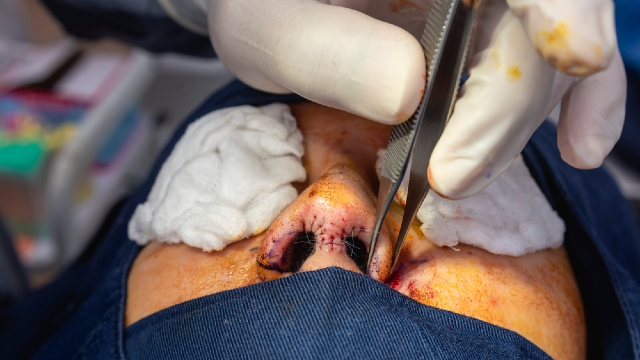
What the nostril actually is
Before any discussion of technique, one anatomical fact reframes the whole procedure.
The StatPearls rhinoplasty chapter, published on the National Library of Medicine's Bookshelf, records that the alae — the curved outer walls of the nostrils — contain fibrofatty tissue rather than cartilage. That is unusual for the nose, where cartilage does most of the structural work, and it has a direct consequence: narrowing the nostrils is soft-tissue surgery, not framework surgery. It does not touch the cartilage architecture that the rest of a rhinoplasty is built on.
This is why alar reduction can be a short, self-contained procedure, and why it is measured in millimeters of soft tissue rather than in grafts and struts.
Two routes, and what separates them
Le.J Plastic Surgery uses both a non-incisional and an incisional approach, and selects between them according to individual anatomy.
The non-incisional route reduces the appearance of nostril width without cutting the alar base. The incisional route removes tissue and closes the gap. Where the clinic uses the incisional technique, the closure is positioned and sutured inward around the curved portion of the nostril, so the resulting scar line curves into the natural crease rather than sitting flat on the outer skin where light catches it.
That detail is the answer to the question most people actually want answered, which is whether the scar will show.
MedlinePlus, the patient-education service of the U.S. National Library of Medicine, is candid about the general case: where a procedure narrows flared nostrils, the incision may be extended around them, and small scars can sit at the base of the nose — scars it describes as not often visible. So the honest framing is not "no scar," and any clinic offering that is overselling. The framing is a small scar placed where the face's own contour hides it.
Why the choice is not made on nostril width alone
Here is where alar reduction goes wrong when it goes wrong: someone measures the nostrils, decides they are wide, and narrows them.
Le.J Plastic Surgery analyzes overall facial proportions before determining how much the nostrils should be reduced, and states plainly that excessive reduction can affect the balance of the nose as a whole. A nostril is not wide or narrow in the abstract. It is wide or narrow relative to the bridge above it, the tip in front of it, and the width of the face around it.
The American Society of Plastic Surgeons frames nasal surgery the same way — as work on nose size in relation to facial balance, on the profile, on nasal asymmetry, and on the size and position of the nostrils specifically. Nostril size sits on that list alongside the other proportions, not above them.
There is a second reason to distrust an absolute standard, and it is anatomical rather than aesthetic. The StatPearls anatomy reference on nose bones records that nares width varies across populations in a pattern that tracks ancestral climate — temperature and humidity — with alar base width at its largest in West Africans and its smallest in North Europeans. There is no single correct nostril dimension to aim at, and a technique that treats one population's average as the target is not doing anatomy, it is doing fashion.
Wide base or flared rim? They are different problems
Two nostrils can both look "too wide" for entirely different reasons, and the reasons call for different operations.
StatPearls distinguishes them directly: sill excisions address a wide alar base, while Weir excisions address alar flare. A wide base means the nostrils sit far apart at the floor of the nose. Flare means the outer walls bow outward above the base. One is a question of how far apart the feet are; the other is a question of how far out the sides curve.
Confusing them produces the two classic poor results — a nose narrowed at the wrong level, or one narrowed too much at the right one. It is a reasonable thing to ask your surgeon to explain about your own nose, in those terms, at consultation.
What the procedure involves
The sequence at Le.J Plastic Surgery is short:
- Facial proportions and individual nasal structure are analyzed to decide how much reduction is appropriate.
- The non-incisional or incisional approach is selected according to your anatomy.
- Where an incision is used, the closure is sutured inward around the curve of the nostril to keep the external line inconspicuous.
- Tape is applied and removed after three days; stitches come out at seven.
The procedure itself takes approximately 30 minutes.
Recovery, in the order it happens

Le.J Plastic Surgery's published schedule has three points on it. Tape is removed three days after surgery. Stitches are removed seven days after surgery. Everyday recovery begins after the stitches are out — which is a later marker than for some nasal procedures, and worth noting if you are planning a trip around it.
Because alar reduction changes the alar area surgically, the clinic describes the result as intended to be long-lasting rather than something that relaxes back over time.
The longer horizon is the same as for any nasal surgery. MedlinePlus puts full recovery from rhinoplasty at a year, with most swelling improved by two to three months. Alar work is smaller in scale than a full nasal rebuild, but the final read on scar appearance in particular is a months-long question, not a weeks-long one. Fresh scars are pink and firm and then they are not.
Risks worth hearing before you decide
Le.J Plastic Surgery lists the possible complications of alar reduction as visible or unfavorable scarring, asymmetry, changes in nostril shape, over-reduction, under-reduction, infection, bleeding, wound-healing problems, and the possibility of revision surgery.
Two of those deserve emphasis because they are specific to this operation rather than generic surgical risks.
Over-reduction is difficult to undo. Tissue that has been removed is not straightforwardly replaced, which is why the clinic's insistence on measuring against facial proportions before deciding the amount is a safeguard rather than a formality.
Asymmetry matters here more than elsewhere because the two nostrils sit side by side and are compared against each other constantly, by you and by everyone looking at you. The American Society of Plastic Surgeons notes that every face is asymmetric to some degree and that the aim of nasal surgery is proportion rather than perfect symmetry — a useful expectation to carry into the consultation.
Who tends to be a candidate
Le.J Plastic Surgery describes candidates as people with wide or flared nostrils who want the nostril area narrowed and the overall nasal proportions improved.
Beyond that, the same general conditions apply as to any elective nasal procedure: general health that makes surgery safe, and expectations that the operation can actually meet. Changing the shape of the nose is among the standard aims of cosmetic surgery listed by MedlinePlus, so the procedure is well established. What varies is whether it is the right procedure for the specific complaint, which is a consultation question rather than a search-engine one.
If you are considering alar reduction alongside other nasal work, that combination is also decided at consultation against your anatomy. Requests go through the clinic's contact page; how the practice plans nasal procedures is set out on its about page.
What to establish at consultation
Four things are worth settling before anything is scheduled, and all four are answerable in a single conversation:
- Which problem you have. Wide base, flare, or a combination — in your nose specifically, not in general.
- Which route follows from that, and what makes the surgeon choose it over the other one.
- How much reduction is planned, and what proportion of your face that figure was measured against.
- Where any scar will sit, and what it is expected to look like at three months rather than at three days.
A surgeon who can answer all four in plain language has assessed your nose. One who answers in millimeters alone has measured it.
Le.J Plastic Surgery's consultation evaluates anatomical structure, medical condition, functional factors and individual circumstances before a plan is drawn up, and an online consultation can be arranged before travel so that the plan is discussed while you are still at home.
The Bottom Line
- Alar reduction narrows wide nostrils and refines the three-dimensional appearance of the lower nose; Le.J Plastic Surgery lists the procedure at approximately 30 minutes.
- Two routes are used, non-incisional and incisional, selected on individual anatomy rather than by default.
- Where an incision is used, the closure is sutured inward around the curve of the nostril to keep the external scar line inconspicuous.
- Tape is removed at three days and stitches at seven, with everyday recovery beginning after stitch removal.
- The amount of reduction is decided against overall facial proportions, because excessive narrowing can unbalance the nose.
Frequently Asked Questions
Will alar reduction leave a visible scar?
Where the incisional route is used, there is a scar, and the technique is about where it sits. Le.J Plastic Surgery sutures the closure inward around the curved portion of the nostril so the line follows the natural crease. MedlinePlus describes scars at the base of the nose after nostril narrowing as not often visible.
How do I know whether I need the incisional or non-incisional approach?
That is decided by assessment rather than preference. Le.J Plastic Surgery selects the approach according to your individual nasal and facial anatomy, after analyzing overall facial proportions to determine how much reduction is appropriate.
How long does the operation take?
Approximately 30 minutes. Tape is removed three days afterward and stitches at seven days, with everyday activities resuming after stitch removal.
Is there a standard nostril width that surgery aims for?
No, and the anatomy argues against one. StatPearls records that nares width varies between populations in a pattern tracking ancestral temperature and humidity, with alar base width largest in West Africans and smallest in North Europeans. Proportion within your own face is the working standard, not a population average.
Can too much be taken away?
Yes, and it is the main risk to discuss. Le.J Plastic Surgery lists over-reduction among the possible complications and analyzes facial proportions before deciding the amount precisely because excessive narrowing can unbalance the nose.
Does alar reduction affect my breathing?
It is soft-tissue work on the outer nostril walls, which StatPearls notes are made of fibrofatty tissue rather than cartilage, so it does not alter the internal framework. Any existing breathing concern should still be raised at consultation, since the American Society of Plastic Surgeons notes that surgery intended to improve an obstructed airway requires careful evaluation of nasal structure and airflow.
How long before the result looks settled?
Longer than the recovery schedule suggests. Everyday recovery begins after stitches come out at seven days, but MedlinePlus puts full recovery from nasal surgery at a year, with most swelling improved by two to three months. Scar appearance in particular keeps changing across that period.
This article is for general informational purposes and does not constitute individualized medical advice. It is not a self-diagnosis tool. Surgical candidacy, technique, and expected outcomes can only be determined through a consultation with a qualified surgeon.
References
- MedlinePlus: Rhinoplasty
- StatPearls: Rhinoplasty (NCBI Bookshelf)
- StatPearls: Anatomy, Head and Neck, Nose Bones
- American Society of Plastic Surgeons: Rhinoplasty
- MedlinePlus: Plastic and Cosmetic Surgery
Ready for a Personalized 1:1 Consultation?
Dr. Kim Ji Sun personally conducts every consultation, surgical plan, and follow-up at Le.J Plastic Surgery in Gangnam, Seoul.